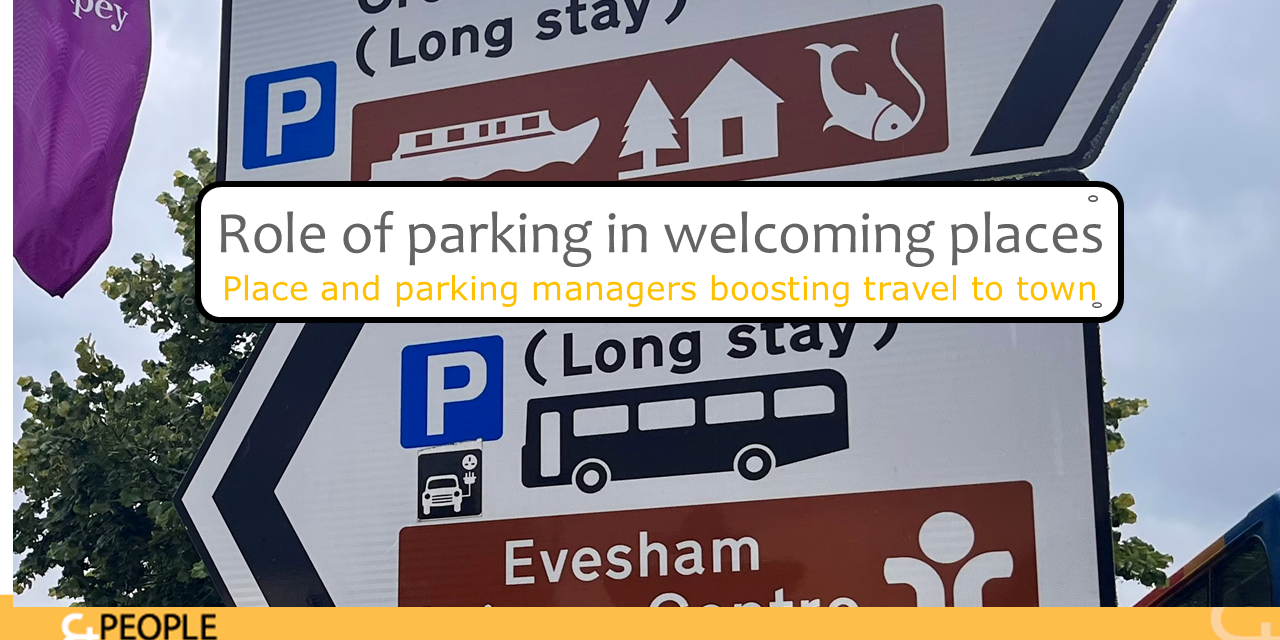
It was a great opportunity for me to be asked the address the role of parking in welcoming places by the organisers of the North East Parking Show. From many of years of encouraging greater collaboration between parking and place managers, I still perceive a gap in the understanding between these two sectors, despite their shared purpose of increasing travel to town.
Disjointed relationship between parking and place
Our analysis of the wider interpretation of parking as part of place is of a disjointed relationship:
- Half of businesses perceive parking as a problem
- Parking potentially a limiting factor in only 20% of towns
- Place leaders lack confidence/capacity to engage in parking management
- Parking managers are focused on white lines & bottom lines
- Uncertainty about links for parking & place within councils
- £1billion p.a. public parking surplus is viewed with ambivalence
Let’s start the from the assumption that, that such a disjointed relationship isn’t the intention of the parking sector. Indeed, let’s take it a step further and say that parking managers share a common purpose with place managers of increasing the number of smiling faces on the streets. Or is the “smiling” over-playing it?
Assuming that this is the case for many progressive parking managers, let’s look at how we can take a fresh look at bridging the gap between parking and place management. The focus here will be on the role of parking in welcoming places.
People, Places and Parking Process
At People & Places we have worked with parking management experts Park Consult to develop our joint People, Places and Parking Process to bridge the gap between disciplines. This proactive process involves:
- Customer-focused approach linking place and parking
- Practical steps forward that also balance the books
- Assesses quality, quantity, cost & community perspective
- Integrates with other options for travelling to town
- Links to our wider ‘sofa to shop’ thinking on trips to town
From ‘sofa to shop’
Our from ‘sofa to shop’ perspective begins with the perspective that the journey begins at home. Why and who is travelling? How do travel choices fit the purpose of their journey and how do we guide the habitual and new visitor differently?
Parking managers can work with place managers to be part of presenting information about parking in way that helps motorist take the best option. This can extend as far as assessing the role of each car park and its suitability for different types of users -from worker to, local leisure shopper, to visitor. Very often, visitor information sites will point to a council’s functional list of car parks with no guidance on what are the best choices for different types of user.
Our joint discussions with parking and place managers are often about setting the right tariff relative to the role of the car park. Something we evaluate by looking at the location of the car park and the role of the town or city. A peripheral car park with an attractive walk to the centre is a bonus for visitors. In our work to support the British Parking Association’s Park Active initiative we describe the aim as creating an “active and attractive” experience.
Parking managers have a wealth of data on the use of car parks. Place managers have detailed information of footfall, foot-flow and increasingly of use by a town’s catchment area. Through our People, Places and Parking Process we analyse and share both sets of data to make informed decisions and set-up agreed indicators for monitoring future change.
Parking and place managers working together
We would summarise the ways in which parking and place mangers can work together to improve the journey to parking & place as follows:
- Provide usable online advice on ‘how to get there’
- Match parking purpose & customer needs
- Link use of data for parking, catchment & footfall
- Agree road signage to help informed choices
- Monitor impacts of promoting parking & place
The ‘on-street’ experience
Extending our look at the journey from soft to shop, we use a detailed checklist to run through the motorists’ experience ‘on-street’. This includes assessing directional signposting and the provision clear information about the purpose of different car parks. Within and adjacent to car parks, we look at and recommend improvements to the orientation and onward way marking information; especially those targeted at visitors.
We consider on-street parking broadly as the domain of “pop-and-shop locals” though we are conscious of the need to coordinate the management and tariffs with off-street parking. This is especially important to residents.
Our associates from Park Consult are on-hand to advise on payment technology though we generally embrace it as making the parking experience easier and more flexible, whilst being aware to engage stakeholders in the thinking around changes.
Creating a seamless parking experience
Our broad philosophy is to make the parking experience a seamless part of visiting a town centre. We seek to guide improvements that enable users to promptly pass through parking to place and would summarise the key elements of this as:
- Coordinating tariffs to balance on- and off-street demand
- Incorporating orientation and onward waymarking
- Using technology to provide a fair and seamless experience
- Targeting re-investment of profits to benefit parking & place
- Accommodating changes in town centre travel & access
In seeking to shape the role of parking in welcoming places, our experience is that there are many simple steps that can be achieved by parking and place managers working more closely together. It very much is a case of where there is a will there is a way for the gap to close in the understanding between these two sectors so that they can more effectively pursue the shared purpose of increasing travel to town.
In this and in all aspects of our People, Places and Parking process, we find there are readily achievable and inexpensive improvements to be made. Get this right and it will leave people feeling better about the place – and maybe even positive about the parking!
Further reading
Read about our work though the People, Places and Parking Process to improve parking for customers and businesses in Salisbury.
Learn more about how we have taken our understanding of town centres and combined with Park Consult’s experience of parking management, to offer a comprehensive and cost effective People, Places & Parking Process consultancy service for councils, business improvement districts and parking providers.
Take a look at the guidance that we prepared for the Local Government Association (LGA) on town centre travel, parking and access; read the LGA case study of our work linking parking and place in Sleaford that uses our process; or contact us at services@people-places.net
Read the Institute of Place Management ‘think piece from People & Places Director, Chris Wade, about how progressive place leaders welcome extra options for travelling into town.