
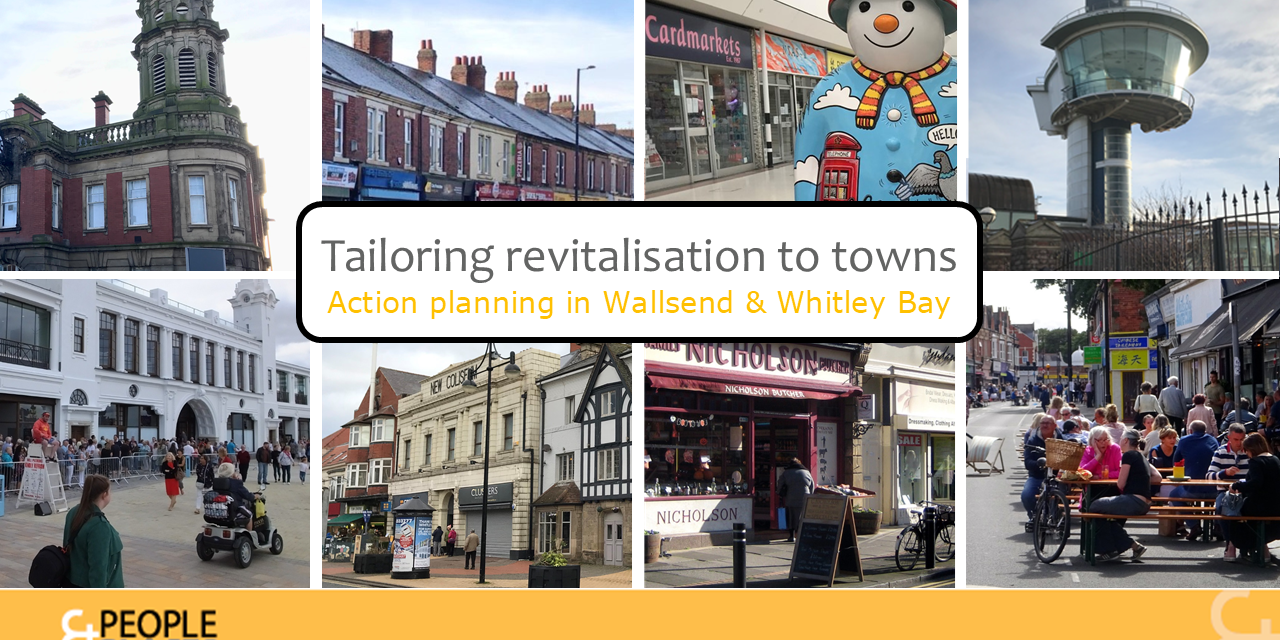
If you are looking to play a part in revitalising your neighbourhood, town or city centre, there are two salient principles that you need to have in mind from the outset. They are demonstrated in this tale of revitalising two towns in North Tyneside.
Based on two underlying principles
ONE: It is an often-said truism, that no place is the same. In looking to turn-around the fortunes of a neighbourhood, town or city centre, it is important to engage with people locally to understand the performance, perceptions and priorities for each place. That way you will get wider, local buy-in to the process of planning and delivering revitalisation.
TWO: The fortunes of places and the people that live and work within them are inextricably inter-connected. Your focus may begin with concerns about the vitality of the ‘high street’, frustrations about the challenges of travelling into town, or a sense that potential place partners are not coordinating their actions. A joined-up, systems-based approach will help create solutions that strengthen the inter-relationships between people and place.
A tale of Wallsend and Whitely Bay
Wallsend and Whitely Bay and two towns in North Tyneside that are only six miles apart. Like many neighbouring towns though, there are clear differences in their purpose, the people they serve and the priorities they face.
Wallsend takes its name from being at the eastern extremity of Hadrian’s Wall and the northern limit of the Roman Empire. It has a rich industrial heritage of coal mining and ship building and is contiguous with the Newcastle urban area. Its town centre consists primarily of a single, long high street with a central civic hub, transport interchange, shopping centre and the Segedunum Roman Fort and Museum.
Whitley Bay is on the coast and grew as a popular seaside resort with its connection by rail to nearby Newcastle from the late 19th Century. It’s role as a destination has been boosted more recently by the makeover its Playhouse, ‘Spanish City’ seafront complex and adjoining plaza. Whitley Bay’s town centre function is dispersed across three distinct zones comprising a central shopping area; Park View ‘village’ and secondary shopping area; the Seafront, Promenade and adjacent roads.
Planning for recovery and transformation
People & Places were commissioned to create action plans for town centre recovery and transformation for six North Tyneside communities in 2021, including Wallsend and Whitely Bay. As the summary presentation about “a tale of revitalising two towns” shows, our approach embraced the principles of assessing the distinctiveness of each place and the interconnections between aspects of the paces and the people they serve.
Our approach adopted the tried and tested national ‘revitalising town centres toolkit‘ that we developed for the Local Government Association that focuses on ‘what’ can change in places by understanding their ‘software’ and ‘hardware’ of places, as well as ‘how’ to deliver change through planning and partnership development. This distinctive approach of understanding the performance, perceptions and priorities of places, alongside the ‘what’ and the ‘how’ of the inter-relationships between people and places, is something we have adapted and strengthened for different situations through our new ‘pathways to place progress’ programme.
Informed by stakeholders’ perceptions
Key to our approach in North Tyneside and more widely, is engaging stakeholders from the outset. In Wallsend and Whitely Bay this involved interviewing over a third of businesses and surveying 742 and 1,346 customers respectively. As the summary presentation about “a tale of revitalising two towns” shows, this confirmed the distinctive use of each town for everyday shopping or days out, and an existing business mix that partly reflected this.
Through the engagement with local businesses and customers, we were able to understanding the big difference in the positive perceptions for each town centre and compare them with our national benchmarks. Customers of Wallsend, for example, valued the convenience and accessibility of the town centre and how it provided important local services. Visitors to Whitley Bay on the other hand, gave a positive portrayal of its hospitality, evening economy, leisure and cultural offer.
Distinctive priorities for places
Engaging with people who live, work and visit places will give useful insights on future priorities in ways that helps them back future changes and reflects differences in the character and capacity of communities.
Customers’ priorities for Wallsend were dominated by diversifying the business mix, improving the town centre’s appearance and strengthening the local ability to deliver. Within this there are demands to diversify the convenience and comparison offer with both independent and household names. There were also strong calls to increase the sit-in hospitality offer whilst limiting the growing number of takeaways. Businesses priorities also included improving parking and promotion of the town to help boost footfall.
Customers’ priorities for Whitley Bay were dominated by improving parking and travel, diversifying the business mix and improving the town’s appearance and accessibility. Within this, there is the distinction that the central shopping area and Park View ‘village’ seem more suited for meeting the needs of local residents, in terms of retail, services and community function. Park View also offers some appeal to visitors with more food & drink options and this role could be boosted through promotion, waymarking and events. The Promenade zone is primarily geared for visitors and tourists, offering accommodation and hospitality. Businesses priorities also included boosting the visitor economy through promotion and events.
Action plans tailored to towns
As this tale of revitalising two towns in North Tyneside shows, such a process of evidence gathering and engagement, embraces the distinctive performance, perceptions and priorities of places. It also focuses on the ‘what’ and the ‘how’ of the inter-relationships between people and places, necessary to bring about widely welcomed change.
The result is distinctive action plans for the revitalisation of individual towns that specify the issues, next steps, responsibilities and impact measures to develop the necessary ‘hardware’ and ‘software’ and build the capacity and partnerships necessary to deliver change.
Award winning partnership progress
Central to the delivery of revitalisation in Wallsend is progress through a strong culture of partnership working, bringing together the local authority, businesses and wider stakeholders to take a coordinated and proactive approach to place management. This collaborative approach has been recognised nationally with Wallsend named as High Street Transformation winner in the Visa Let’s Celebrate Towns Awards 2025. The awards celebrate towns that demonstrate resilience, innovation and strong local leadership, highlighting places where businesses and communities are working together to support thriving local economies.
Whitley Bay continues to demonstrate its local capacity and partnership working through the ‘Our Whitley Bay’ social media campaign led by the town’s Chamber of Commerce. The campaign has 50,000 followers between Facebook and Instagram and we often cite it as an example of locally-curated social media that achieves a great balance between authentically promoting a place and facilitating a positive dialogue.
Delivering ‘pathways to place progress’
At People & Places, we realise that these are uncertain times for communities faced by what seems an ever-deepening set of issues and institutional uncertainty with the roll-out of devolution and local government reorganisation. At the national level, there seems to be increasing mention of the importance of ‘place’ and murmurings about community empowerment, without a readily available route to see how this translates down to individual communities. That’s why we have put together this new programme for ‘delivering pathways to place progress’, through the practicalities of ‘partnerships, plans and projects’. The pathways programme extends the distinctive approach shown in our work in North Tyneside, by strengthening the focus on the ‘how’ (people & partnerships) of revitalisation in ways that can be applied across neighbourhoods, town and city centres.
Contact services@people-places.net for more information about the ‘pathways to place progress’ support programme.
Postcards from places
This tale of revitalisation in North Tyneside is part of the ‘postcards from‘ section of our websites that includes case studies from different places of where we have worked in different ways. Other case studies in the series include:
How to turn around a town centre focusing on the role of place partnerships in the Causeway, Coast and Glen District of Northern Ireland.
Improving Hereford’s look and feel focusing on the ‘software’ involved in revitalising a town or city centre.
Balancing parking and access during town transformation that covers the application of our People, Places & Parking Process as part of wider revitalisation.
Reviewing access and signage in the Malverns that shares how to imorive the way people travel into and around town centres.

