The interesting aspect of the recent announcement for the Visitor Levy in England, is not the decision made that it is going ahead -that’s been a foregone conclusion since last year’s Budget. The key decisions are the ones still to be made by Strategic Authorities about how they will be making the most of the Visitor Levy in the ways it can be spent.
Devolution surely needs to apply through the ability of Strategic Authorities to work with local partners and adapt to local needs and circumstances in making the most of the Visitor Levy. In this article, we focus on the use of the funds collected through the Levy, though devolved decision-making can also determine the level of the Levy and the local engagement and accountability in administering it, including the involvement of regional Local Visitor Economy Partnerships and more localised Business Improvement Districts.
Flexible Government guidance
The Government’s position is a flexible one that says the Strategic Authorities will be responsible for decisions on how the levy revenues can be used. The Government proposes that English Strategic Authorities could spend revenue from the Levy on “broader initiatives which have a positive impact on the region’s economic health”.
The Government view is that Strategic Authorities are well-placed to ensure that in making the most of the Visitor Levy, account is taken of strategies such as Local Growth Plans. Using powers granted to them under the English Devolution and Community Empowerment Act, Strategic Authorities have powers and competencies, which include economic development, and encouraging visitors to their area.
Learning from Scotland
The flexibility in how English Strategic Authorities can take a lead in making the most of the Visitor Levy, offers a broader use of the income than is permitted in the Scottish and Welsh systems, which require revenues to be spent on matters related to the visitor economy and destination management.
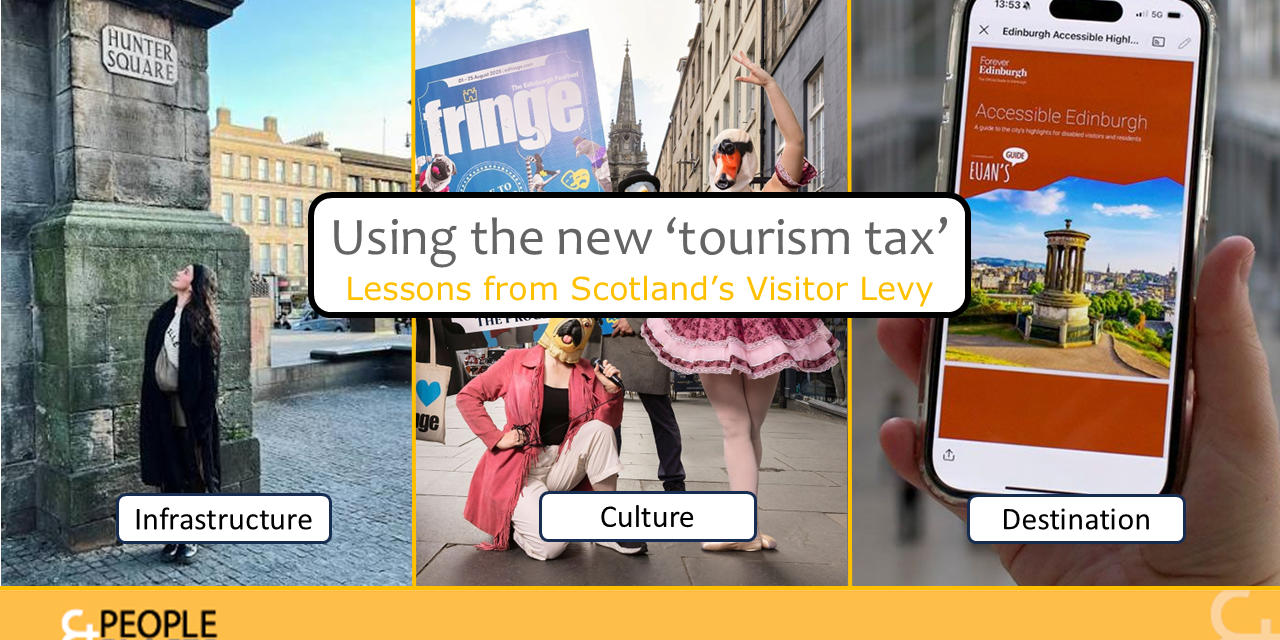
In Edinburgh, for example, where the Visitor Levy that has been collected since July 2026, the revenue can only be used for initiatives that sit within three investment programmes, as agreed by the City Council in January 2025.
City operations and infrastructure
These projects will be delivered through two key funds:
- The Well-Kept City Fund will help to revitalise the city through a range of clean, green, safe, well-maintained and sustainable infrastructure themed projects.
- The City Transformation Fund involves ambitious projects to renew and restore key areas of Edinburgh, both in the city centre and across the city.
Culture, heritage and events
These spend programmes will invest in Edinburgh’s culture, heritage and events scene to deliver lasting benefits for visitors and residents. The aim is to make sure Edinburgh remains a vibrant, inclusive cultural capital city and this funding will be delivered through three key programmes:
- Cultural Organisations – Edinburgh Open 365: Investing in and supporting Edinburgh’s cultural organisations to innovate and generate new world class content for the whole city, all year round.
- Our Cultural Infrastructure: Investing in Edinburgh’s cultural and heritage locations to secure their futures as high-quality visitor destinations, green, creative and well maintained, spaces.
- Large Scale Cultural Capital Fund: Completing major transformation projects in line with the City’s Culture and Tourism Strategies.
Destination and Visitor Management
The aim through this strand is to make sure people across Edinburgh feel the benefits of the Visitor Levy by strengthening awareness and demand for the city’s diverse and year-round offer. This will will be achieved through two spend programmes:
- Destination Marketing and Management: Strengthening awareness of Edinburgh’s diverse, year-round offer by inspiring visitors and residents to explore beyond the well-known attractions in the city centre, leading to more balanced visitor numbers and impact around the city, throughout the year.
- Industry Sustainability and Fair Work in Tourism: Providing direct support for businesses in the visitor economy to improve economic and environmental sustainability, fair work and innovation and help the sector to be more resilient, ethical and ready for the future.
The example of Edinburgh comes close to what is known as ‘hypothecated’ taxation, where revenue from the levy on the visitor is ring fenced only for related investment. This is a form of taxation not traditionally popular in the United Kingdom though you can see the clarity it offers and the focus provided for discussions about making the most of the visitor levy between public, community and tourism sector interests. Maybe it’s a model that works closer with regional government through Strategic Authorities and their more locally accountable.
Learning from Europe
The use of ‘tourism taxes’ of some sort is well-established. In France for example, its use stretches back over a century in some popular visitor destinations. Here are three examples that indicate differences in how it is collected and usedin different countries and regions:
- France; The more than €1 billion raised annually must be spent by councils “to encourage tourism in the district”, according to French law.
- Spain: Spanish regions determine how tourist taxes are collected and used. Catalonia, for example, charges a fixed amount per person per night according to the type of accommodation. Since April 2026, 25% of Catalonia’s tourist-tax revenue has been earmarked for housing, with the remainder going towards tourism-related spending.
- Greece: Greece’s tourism tax has been revamped in recent years and is now known as the “climate crisis resilience fee”. It is designed to fund the prevention of and recovery from climate-related disasters, including wildfires and floods.
Government response to national consultation
The Government response to the Visitor Levy consultation carried in autumn 2025, is an uninformative document, for all the time put into preparing it. For one thing, whilst summarising the nature of respondents, it appears to give no difference in weighting to responses from representative bodies of the Visitor Economy, public authorities or private individuals.
For what it is worth, consultees’ responses to the Government consultation are presented as a vague and quantifiably misleading summary that they “generally agreed (45%, 557 of 1223) that levy funds should be invested to support economic growth, including in the visitor economy“. Seemingly, responses cited positive impacts on local communities and the opportunity to encourage investment in key services and tourist attractions. 40% (485) did not agree with this approach, 15% (181) provided no answer. Those who disagreed expressed concern that revenues may be used for general service pressures locally rather than to benefit growth and the visitor economy, and the need for clearer transparency rules, which were covered later in the consultation.
A figure of 45% “generally agreed” against 40% “did not agree” gives a lot of room for needing to understand the nuances of qualitative answers including from Visitor Economy representaive bodies and public authorities, as opposed to private individuals.
Strategic Authorities to consult locally
The Government guidance is that it will be for Mayors and other Strategic Authority leaders to consider how best to engage local stakeholders on decisions about making the most of the Visitor Levy. They suggest that this could include, for example, accommodation providers, Local Visitor Economy Partnerships, local authorities and other hospitality businesses, communities and, where practical, visitors.
This is partly where Mayors and other Strategic Authority leaders need to be able to develop devolved approaches that take account of existing networks and organisations, including Business Improvement Districts. Because Strategic Authorities operate over large areas, they will also need to ensure that there are robust policies for determining the geographical use of the Levy, relative to cities, coastal towns, National Park areas and other locations where it might be mostly collected.
Estimated Levy income
Some initial estimates of the likely revenue from a visitor levy published by the BBC suggested that a modest £1 per night levy in London could raise £91 million per year. Figures suggested for other areas include £11 million for Liverpool City Region; £8-40 million for Greater Manchester; and a huge £52 million for York and North Yorkshire. The first levies are likely to be collected from Spring 2028.
In tandem with the latest announcement about the go-ahead of the schemes, Mayors in regions under Labour administrations have pledged to cap a new fee on visitors’ overnight stays at 5%.
Initial responses from English Mayors
Not surprisingly, the recent announcements have been broadly welcomed by the Mayors of English Strategic Authorities. The initial responses such that they will work with the tourism sector and their communities in making the most of the visitor levy, though there would be some flexibility for it to be used beyond benefitting or mitigating impacts of ythe Visitor Economy.
Commenting at the time of the recent announcement, David Skaith, Mayor of York and North Yorkshire, indicated that the application of the Visitor Levy will be determined through a full public consultation and more engagement with the hospitality and tourism sector. He opended the door to its flexible use by adding, “I know that people want to see improvements to our town and city centres, investment in our public services, and us showing off just how great our county is. That’s what money raised from a visitor levy will help us deliver.”
Steve Rotheram, Mayor of the Liverpool City Region, commented, “Visitor Levy mechanisms are often used in many great cities across the globe to improve the visitor offer and attract even more people to enjoy the experience. It would give us more money to support the things that make our visitor economy such a success, while helping our businesses and communities to benefit from its continued growth.”
Mayor of London, Sadiq Khan, followed the approach of Government and others in referencing the Visitor Economy whilst also talking more broadly about ‘growth’. He said, “A well-designed, modest levy has the potential to provide an important additional source of funding to support growth, strengthen London’s offer to visitors and help us remain globally competitive. It would allow us to reinvest in the places, infrastructure, culture and experiences that make London one of the world’s greatest cities to visit, while helping manage the pressures that come with welcoming tens of millions of visitors every year“. He committed to work closely with London’s boroughs, accommodation providers, hospitality and tourism businesses and other partners, before final decisions are taken.”
Elsewhere, Mayors representing Greater Lincolnshire, Hull and East Yorkshire, Cambridgeshire and Peterborough, and the Tees Valley have ruled out applying the Visitor Levy over the areas that they cover.
Further reading
You can keep up-to-date with news about the Visitor Levy and other policy news through out Place Policy Checklist.
Read about our practical steps for improving visitors’ experiences of town and city centres through our support for ‘improving the journey from sofa to shop‘.
At People & Places, we are leading advocates for strengthening the link between how towns and cities are experienced and promoted through our work to bring together approaches to place management and branding in ways that help in ‘promoting pride in place through progress’. This includes analysis of international indices of place identity and quality of life to provide insights on influencing our experiences and perceptions of places.