How does where we live affect how healthy we are? This extended article looks at the opportunities for creating healthier places through community-based partnerships that combine public health and care aims. It also considers what, if any, might be the similarities and overlaps with wider place-based, partnership approaches to improving local quality of life.
Overlapping health and place priorities
There is growing understanding about the relationship between places and the health of people who live there or access local services. This includes tactical guidance about the inter-relationship between accepted place management practice and localised health benefits. At a global level it is equally reflected in the way healthcare features in leading international indices of city liveability.
This article will look at and beyond such accepted thinking, to an evolving body of practice that takes a community-based approach to improving health by integrating local services and engaging citizens. Such approaches focus on creating healthy places through partnerships, in ways that might not make explicit links to how places are managed more widely. This article will seek to consider the commonalities with wider place partnerships and management techniques. As such, it will be seeking to begin to explore the overlaps between partnership approaches for how ‘health is managed within places’ and the ways that ‘place management contributes to improved health’.
Creating healthy high streets
The increasing understanding about the relationship between how places are managed and the health of local people, is demonstrated, for example, in the findings of the Royal Society for Public Health’s (RSPH) recently published Streets Ahead report. The report shares research and guidance on “building health on the high street”.
The Streets Ahead report highlights ten building blocks of a healthy high street as community empowerment, transport links, inclusive design, safety, good quality retail, social spaces, health services, healthy food, green spaces and supportive work. It sets-out how to positively influence the health of people who visit high streets in ways that will also help communities thrive. Chief amongst their calls are proposals for coordinated delivery with a strong leadership, clear accountability and long-term funding that could help improve the health on the high street.
Providing neighbourhood health services
In the U.K., added impetus is being given to providing creating healthy places through plans to intervene at different scales of ‘neighbourhood.’
Through the NHS and Government’s 10 Year Health Plan for England, Fit for the Future, proposals are set-out for a ‘Neighbourhood Health Service’ that will aim to bring care into local communities, convene professionals into patient-centred teams and end fragmentation. This will be backed by a shift in investment with plans for the delivery of 120 new Neighbourhood Health Centres within 5 years, as local areas build and expand their services.
In this approach, the NHS appear to define neighbourhoods on a much larger scale than elsewhere within government, with ‘single neighbourhood providers’ delivering services over single neighbourhoods (c 50,000 people) and ‘multi neighbourhood providers’ (250,000 people) working across several different neighbourhoods.
At a different scale, improving local health and wellbeing is one of multiple objectives for community-led local boards as part of the Pride in Place Programme. These programmes are most often pitched at hyper-local neighbourhoods of around 2-4,000 residents that facing multiple deprivation. Eligible interventions include supporting community-level health provision; integration and co-location of health and wellbeing services; support for local sport and activities; and funding for support groups or specialist advice services.
Community underpinning health and wellbeing
Such neighbourhood approaches, create the opportunities to build on established guidance from Public Health England about how ‘community’ influences health and wellbeing. This takes the approach that positive health outcomes need to be achieved in-part by factors that underpin them at a community level. This is founded on an understanding that community life, social connections and having a voice in local decisions, are all factors that have a vital contribution to make to health and wellbeing.
The overlap between such guidance on community-centred approaches for health and wellbeing, has striking similarities to a wider ethos of participation in place management. Involving and empowering local communities, and particularly disadvantaged groups, is considered central to local and national strategies in England for both promoting health and wellbeing. Participatory approaches can directly address marginalisation and powerlessness that underpin inequities and can therefore be more effective than professional-led services in reducing inequalities.
Taking Asset-Based-Approaches
Such thinking aligns with moves across the U.K. and Europe that increasingly use Asset-Based-Approaches (ABAs) as part of a potential solutions to inequalities. Again, this has striking parallels to thinking around the community-led, wider revitalisation of places. As well as having health needs, the thinking embraces that all communities have health assets that can contribute to the positive health and wellbeing of its citizens, including:
- the skills, knowledge, social competence and commitment of individuals
- friendships, inter-generational solidarity, community cohesion and neighbourliness
- local groups and community and voluntary associations, ranging from formal organisations to informal, mutual aid networks such as babysitting circles
- physical, environmental and economic resources
- assets brought by external agencies including the public, private and third sector
Recognising assets helps value community strengths and ensure everyone has access to them. It builds on the positives and ensures that health action is co-produced equally between communities and services. Such an approach is considered to not be about expecting communities to do more and saving public money but about investing in more sustainable and effective approaches, alongside other provision.
Wigan and Greater Manchester case study
Addressing health as part of wider devolution
Wigan within Greater Manchester is an example of what is described as a place-based partnership working to address inequalities in health by breaking down silos and agency boundaries that can get in the way of people-centred outcomes within communities. It’s also an example of ABAs as potential solutions to inequalities.
Wigan is the second largest borough in the Greater Manchester and was therefore, as part of the area’s devolution settlement, party to a historic Memorandum of Understanding to develop a place-based framework for joint decision-making on integrated health and social care provision. This is portrayed as representing a significant shift to locally determining how resources are most effectively deployed to work with local citizens to improve health and reduce long-standing health inequalities. It also harnesses the potential of the wider Greater Manchester devolution framework to be able to collectively consider interlinked health determinants of: employment, planning, housing, transport, skills, education and leisure, with the integration of health, social care and well-being services.
Creating a Healthier Wigan Partnership
In Wigan, there was extra impetus created by the development of the wider ‘Wigan Deal’ that sought to establish a new relationship between public services and citizens, communities and businesses, that equates to “do with, not to”. As an ‘asset-based approach’ it was a receptive home for an approach to integrating health and well-being in ways that recognise and build on the strengths of individuals, families and communities rather than focusing on the deficits. The Wigan Deal had started its transformative approach with changes in adult social care. Two years on, the Wigan Deal was well-placed to embrace the ‘Healthier Wigan Partnership’ as an alliance of health and care providers and commissioners. Key service components included reformed primary care in clusters of 30-50,000 population; a shift of hospital activity (diagnostic and treatment) to community facilities; place-based working across health, care and a wider range of public and voluntary sector services.
Lessons from participation and partnership working
Beyond such structural changes in health and care services, identifying and linking with citizens as change agents with an enthusiasm for promoting health and wellbeing, was a key way of building community and system-wide commitment. As part of Wigan’s “Health Movement for Change”, 23,000 citizens were engaged in roles that included: 1,350 Health Champions; 495 Heart Champions; 856 Cancer Champions; 10,000; Dementia Friends, and 200+ Young Health Champions.
Asset-based community development as per Cormac Russell’s approach, was part of enabling “different” conversations between the citizen and frontline staff, focused on strengths and co-creation with, as opposed to “doing to”, as part of a change in organisational behaviours and culture. An “expert on tap rather than expert on top” approach enables investing in the ideas, talents and passions of local people as core to a “citizen-led” public health.
Links to healthy communities through sport
Greater Manchester is also one of 12 places working with Sport England on a new approach to build healthy, more active communities. The GM Moving plan sets the framework with its shared principles and priorities, and each GM districts has its own local delivery pilot. In Oldham, for example, investment was made in the expertise of voluntary, community, faith and social enterprise bodies who often already have the trusted relationships and connections in place that are so central to success.
Increasing the impacts of health-based, place partnerships
What elements should be taken into account to create asset-based and place-based partnerships and how can this be accelerated? Here we summarise guidance on health-based partnerships developed by Viola Cassetti for the Local Government Association. The commonalities to guidance appropriate for wider place partnerships is striking. Here is a summary of what to take into account in creating and accelerating the impacts of such partnerships.
- Putting people and communities at the centre of inter-sectoral health actions: Participatory approaches such as co-production and co-creation can support the development of partnerships. This should include the views and voices of the people and communities whose health is to be promoted.
- Taking into account of the local context: Each place has its own context and dynamics and these will influence how a partnership is formed, who participates in it and how it relates to the wider community. It is important to understand such influences because these are part of the local knowledge, expertise and context which a partnership can build upon.
- Creating inclusive partnerships based on trustworthy relations: Partnerships should be inclusive. In an inclusive and equal partnership, each stakeholder should be considered as an expert in his or her field and the knowledge which that person brings to the table should be valued as such. It is important to include a diversity of members to better represent the membership of the community whose health the partnership aims to improve.
- Allowing time to develop those cross-sectoral relationships: Stakeholders from different sectors should participate equally. Time is needed to develop these cross-sector relationships; to identify common goals; to develop trust and collaborative leadership between partnership members; and recognise each other’s strengths and capacities. Intersectoral work can become a way to build social capital and work using an assets-based-approach.
- Communicating as equals and speaking a common ‘language’: Most often there is an assumption that all stakeholders in a partnership speak a ‘common language’. However, a shared understanding of an issue and developing shared goals and visions takes time to develop. The ways in which communications flows within a partnership can determine the results that can be achieved collectively.
- Moving beyond a ‘silo-outcomes’ approach: If the intervention is intersectoral so should be the results to be achieved. Outcomes should stop being related to only one sector. Mechanisms to support cross-sectoral planning and evaluation can facilitate the work of partnerships.
- Ensuring partnerships are supported and resourced: Such a re-orientation towards implementing effective intersectoral work needs to be endorsed by the wider system with both human and financial resources provided. For example, creating a dedicated health promotion unit and ensuring funds are specifically provided for intersectoral work could support such a re-orientation.
- Encouraging anchor institutions to become partners in local health alliances: Anchor institutions are institutions with financial capital that are ‘anchored’ in communities, i.e. they are not likely to go away if a crisis come or market trends change. They are generally non-profit organisations, mainly public (such as hospitals, health centres, universities) and are place-based. They can become an important asset in the fight to reduce health inequalities as they become drivers of local economic development and could ensure sustainability and support to the local health initiatives.
- Working collaboratively with the social and voluntary sector: Civil society organisations provide services aimed at improving the health and wellbeing of the people in their communities, as well as tackling the social determinants of health across the life course and should be key stakeholders to engage. The third sector can potentially be the leader for this change towards people-centred partnerships informed by an ABA.
- Fostering a ‘Health in All’ policies approach: Activities across different government sectors and levels should take into account the health impact that they can generate. This can act as a leverage for the health system, supporting a re-orientation towards a more people-centre healthcare; and identifying solutions to some of the health issues where the causes are more social than biological.
Learning for creating heathier places
Here, we capture the learning from this article about the overlaps between partnership approaches for how ‘health is managed within places’ and the ways that ‘place management contributes to improved health’. We have identified the following overlaps in learning to inform further understanding and application.
- Inter-sectoral approach: Improving health outcomes in places goes beyond restructuring health service provision and crosses-over into inter-sectoral approaches that includes obvious disciplines such as sports, as well as wider delivery of policies for employment, planning, housing or transport, for example.
- Application to ‘communities of identity’: It is probably especially helpful in the case of health outcomes, to consider partnership working as relating to ‘communities of identity’, rather than being simply ‘place-based’. This can also be helpful to focus wider place management on people and social outcomes.
- Putting partnerships in place: A community focus on health outcomes through inter-sectoral working, can be aided by collaborations through partnership working at appropriate scales, and could be part of a wider, place management and local governance approach.
- Partnership development good practice: Many of the lessons for place partnership development are universal, whether the focus is on improving health or wider revitalisation.
- Integral role of community participation: Community-based health solutions and wider wellbeing can be shaped by participation and so can be appropriate to include as part of wider engagement.
- Health outcomes as part of wider place management: There is a strong cross-over between health and wider place management outcomes, and so good for them to be overtly recognised from the outset, whatever the initial impetus.
- Strategic and tactical relationships: The relationship between the strategic nature of area/community-based, health partnerships and tactical interventions at the local neighbourhood level, such as through Pride in Place, is akin to that for other aspects of place management.
- Application of Asset-Based-Approaches: The use of ABAs can apply equally well to health as other aspects of place management, and so can be considered a unifying philosophy.
- Potential of community anchors: Community anchor and civil organisations can have a core role in participation and delivery of health and wider place management outcomes.
- Involvement of ‘community champions’: The role of ‘heath champions’ has parallels with applications of residents and other stakeholders in ‘ambassadorial’ roles in other aspects of place management.
Wider place management perspective
From a wider place management, local governance and community empowerment perspective, what is striking from this review is how a focus on creating healthier places, can be readily included as part of such approaches. The commonalities in achieving a community focus through place-based partnerships using asset-based-approaches, suggests very compatible methodologies. That health outcomes are inter-linked with wider issues and potentially shared interventions, suggests that they might best be delivered through such methods. It would seem that the overlaps between partnership approaches for how ‘health is managed within places’ and the ways that ‘place management contributes to improved health’, are much greater than either sector might initially anticipate.
More information
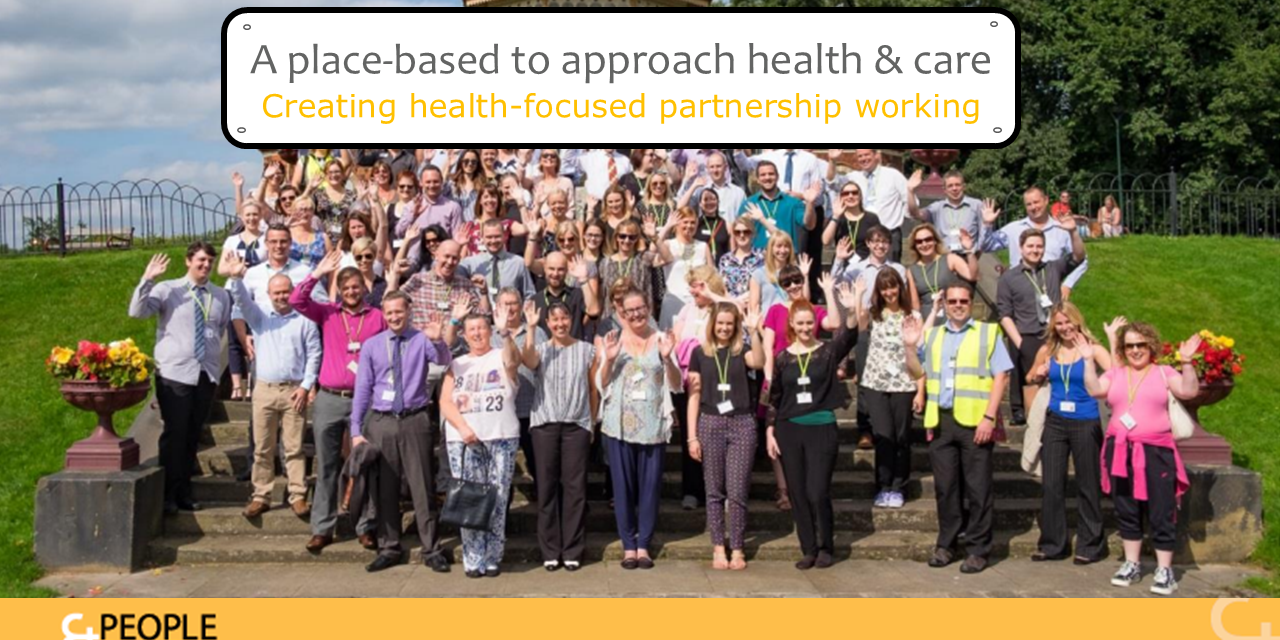
Photo shows ‘health champions’ as part of Healthier Wigan Partnership.
Read about our proposed Community Participation Wheel for partnerships. This is part of our creation of wider training courses on community engagement and place partnerships. We can use these to provide bespoke training to your place partnership, neighbourhood board or similar, as well as directly guiding you in determining your strategy for community engagement, participation and empowerment.
Find out about our analysis of a younger view on pride in place. This analysis is part of broader research that underpins our work undertaking stakeholder engagement, place partnership development, strategy preparation and project delivery.
Take a look at our top ten tips for creating a place partnership behind a plan. You can download a copy of our Checklist of Steps for Creating Place Partnerships for a self-help diagnosis or potentially as prompts for mentored interviews conducted by us at People & Places.
Contact services @people-places.net for more information about we can help develop evidece-based and effective place partnerships for your neighbourhood, town or city centre.