
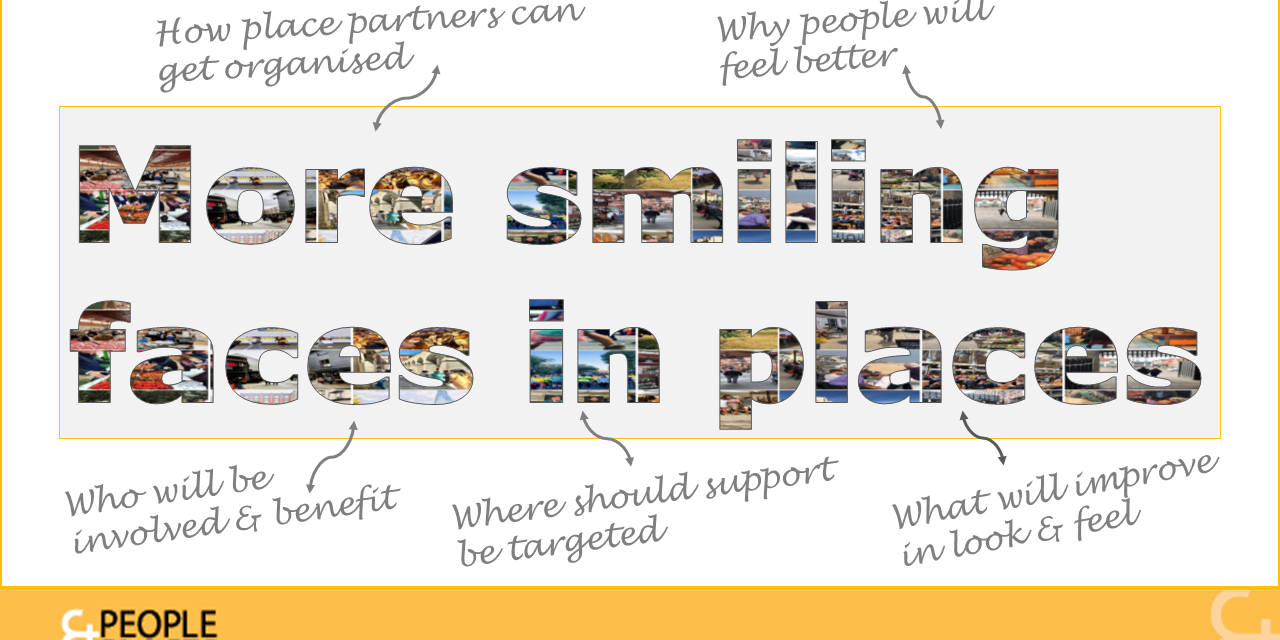
How much of national policy and local practice in revitalising neighbourhoods, town and city centres comes down to achieving a simple aim of …’getting more smiling faces in places’? At the People & Places Partnership, we have adopted this simple mantra to provide a focus for our work with councils and communities and commercial interests. We also feel it has wider applications in providing a common aim from national policy to local practice.
Simple shared aim to cut through complexity
Revitalising places can involve coordinating a complexity of disciplines to meet the needs of a wide variety of stakeholders. we have also learnt though, that often it can be helpful to focus on a simple shared aim that partners can be reminded of and readily reflect on.
Whilst it started as a flippant remark, and we still use it in inverted commas, more and more we find that ‘getting more smiling face in places’ defines the support that we provide at People & Places. It can serve as a wider reminder of the importance of people, in an outcomes focused way, that can include issues as diverse as economic vitality and a place-based focus to improving community health.
How, what, who, where & why
Though a seemingly simple aim, seeking ‘more smiling faces in places’ can be revealed to have elements of both a distinct and common focus, if we explore the how, why, who, where and why of achieving it:
- How: With a focus on ‘how’ to deliver change in places, it is important to recognise differences in disciplines and how, say a BID or neighbourhood health group operate, as well as the potential for such a simplified aim to identify a common purpose for working in partnership.
- Why: Likewise, across disciplines, the reasons why people are feeling more positive may differ and could be due to the wider prosperity of the population, improved personal health, or improved perceptions and experiences of say a city centre. It is good to understand that these can impact on how manay people are enjoying a place.
- Who: Different disciplines will focus on different groups of people from potential tourists, to prosperous local residents or those experiencing aspects of deprivation. Focusing on who are the different ‘faces’ that might be prompted to come and enjoy places like neighbourhood facilities or town centres, distinguishes their different needs as well as identifying overlaps in the perceptions and experiences of places such as accessibility, safety and the cultural offer.
- Where: Determining which places should be targetted through initiatives such as the U.K.’s ‘Pride in Place’ programme, for example, is inter-linked with the first three factors, and in fact saw a shift from wider town centres to tightly defined neighbourhoods during its development. As part of this it is important to understand that people’s needs will be served by various places and impacted by ytheor ability to move between them.
- What: With many of the aforementioned factors influencing people’s use of places understood, it is more possible to determine what factors of improving the ‘look and feel’ of neighbourhoods, town or city centres, will help different people appreciate and enjoy them.
From a seeemingly simple aim of ‘more smiling faces in places’, such wider exploration helps us understand the importance of the different components and how they determine the distinctions and overlaps between disciplines and audiences.
Building on three principles for place progress
Whilst such a shared aim may seem simple, it sits at the head of a wider approach that we advocate in delivering pathways to place progress, based on three key principles:
1. Built on track record of revitalising places
It builds on the approach that we took in preparing the national ‘revitalising town centres toolkit‘ for the Local Government Association and our track record of applying it in around 50 places, illustrated by these national case studies of our work in Suffolk and North Yorkshire. This distinctive approach focuses as much on the ‘how’ (people & partnerships) as the ‘what’ (plans & projects) of changing the ‘look and feel’ of places.
2. Meeting place partners’ collective needs
A focus on ‘smiling faces in places’ can work well with partnerships involving or led by a variety of groups from ‘anchor organisations’ looking to increase their impact and influence; town councils or Business Improvement Districts looking to have both stronger strategic influence and community engagement; and local, unitary and combined authorities seeking to link local delivery and strategic policies. It provides a common focus for different disciplines and levels of governance to work collectively.
3. Putting partnerships and plans before projects
Our approach is based on the belief that local needs, encapsulated in the concept of ‘smiling faces in places’, are better served in the longer-term by engaging from the outset with stakeholder groups, businesses and citizens to understand the role they might want to play in a ‘place partnership’. Our research into influencing people’s experiences and perceptions of places will can help frame action planning about what boosts the appealof places to residents, visitors and potential investors.
Free downloadable guide
Our new online and downloadable guide sets out different practical ways for helping communities get ‘more smiling faces in places’. It includes a variety of profile pieces of successful good practice to hopefully inform or inspire such actions more widely. It provides an overview of the following approaches to achieving changes in how places are perceived experienced, from holistic pathways to practical improvements in improving the ease and appeal of travelling to town:
Pursuing pathways to place progress
- Planning & delivering revitalised town centres
- Leading change through a partnership approach
Boosting pride in place
- Following 10 steps for creating places to be proud of
- Nurturing people’s sense of pride through participation
Improving the journey from sofa to shop
- Improving the appeal & ease of travel to town
- Linking parking & place through a customer-led process
Help to achieve more smiling faces in your places
Improving places with and for the people that they matter to, can of course become complex. We have found though that a simple shared aim of ‘more smiling faces in places’, can keep the partners, processes and projects, focused on the desired end result. If you think it can be part of a necessary outcomes focus for you and your work, get in touch via services@people-places.net for a chat. We are always happy to help place leaders and partners in getting more smiling faces in their places!

