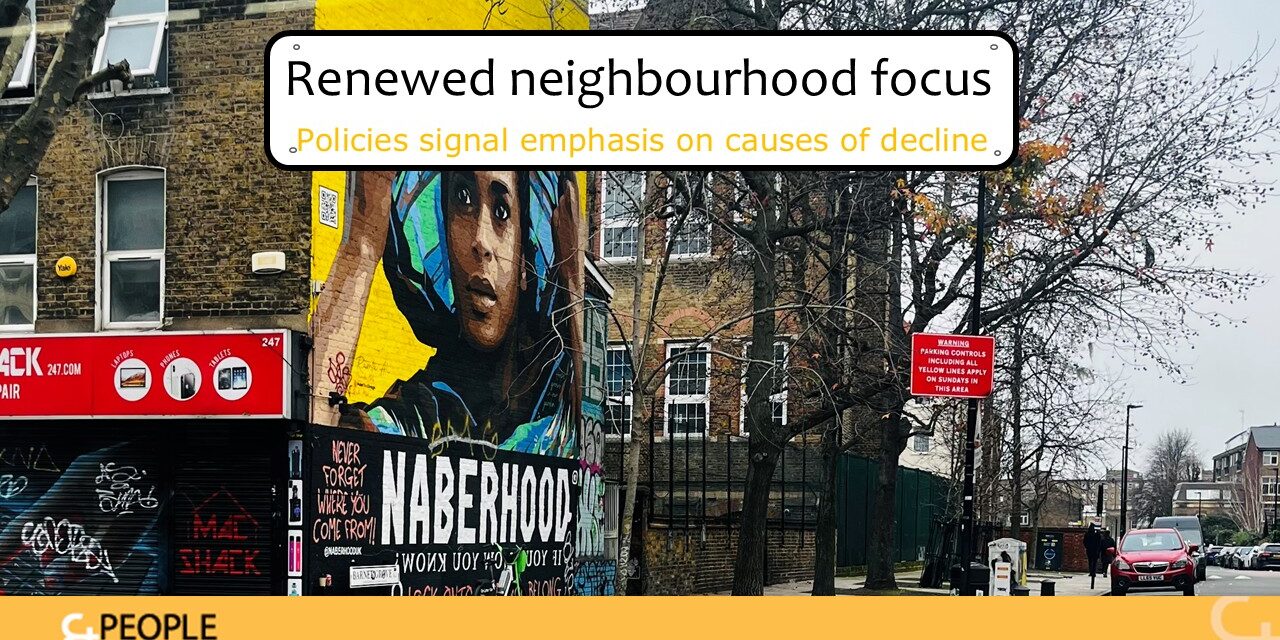
What should we read into signs of the government’s place-based approach increasingly focusing policy on neighbourhood renewal? This March saw the publication of two key pointers to such a government focus on addressing decline at the ‘neighbourhood’ level. The rebranding of the Long Term Plan for Towns to the Plan for Neighbourhoods, was accompanied by the publication by the Independent Commission on Neighbourhoods of its interim report, Think Neighbourhoods.
Tougher on the causes of decline
To coin a phrase, we feel that focusing policy on neighbourhood renewal is consistent with the wider government ethos of “tough(ish) on decline; tougher on the causes of decline”. In relation to town centres, the thinking appears to be that if the prosperity of the communities around them improves, there may be a “trickle-up” effect to the centre. Whereas the previous focus sought to improve high streets with deprived areas in their catchments, the rebranding emphasises that the battle is being taken to the neighbourhoods where the people live.
Defining neighbourhoods
So, what is a neighbourhood? It seems it’s something you can feel though not readily define. The Independent Commission on Neighbourhoods in its recently published interim report on addressing disadvantaged neighbourhoods, explained that it is a term popularly understood to mean anything from a local town, to part of a town or the streets immediately around where you live. For their analysis the Commission uses the statistical unit of the ‘Local Super Output Area’ (LSOA). A medium-sized town might comprise of 10-15 such Output Areas.
In its guidance on Neighbourhood Boards and place boundaries, the Government’s Plan for Neighbourhoods takes in a much wider geographical sweep. This states that the default boundary for each place is determined as the whole of the continuous urban area. For England and Wales this is equated to the built-up areas as defined by the Office for National Statistics that includes the town or city centre and all surrounding neighbourhoods.
Rebranding of funding
The £1.5 billion Plan for Neighbourhoods is a subtle rebranding of the previous Long Term Plan for Towns. The 75 beneficiary communities that will each receive £20 million to create a plan for the long-term, are the same. And yet the expectation seems different beyond a new government simply saying that this is our scheme now. The focus switches more to the people within the place and away from an emphasis on large capital schemes associated with Levelling Up.
The first challenge for the 75 towns participating in the Plan for Neighbourhoods would seem to be to redefine or reaffirm the target neighbourhood(s). With the scope broadened to reference health and crime alongside improving economic prosperity, the second challenge would seem to be determining priorities that add value for their communities rather than backfilling the real and figurative ‘potholes’ caused by public spending cuts.
Limited time to realign locally
Living up to ministerial rhetoric about engaging and empowering communities would seem an important part of the wider challenges, though there is very limited time to realign propopsalslocally. Each of the 75 places has just over a month to confirm the Chair and composition of Neighbourhood Boards as an evolution of what might already be in place. If such set-ups are to learn anything from previous experience, they should see themselves as concerned with much more than just the effective allocation of a single pot of funds. They should be set-up in a way to work alongside the moving landscape of existing local governance in ways that leverage influence and impact.
The Plan for Neighbourhoods Prospectus justifies the continued selection of the areas by the curious statistic that, “49 of the 58 English towns are in the top 20% most deprived built up areas in the country”. Which apart from highlighting that 9 of the towns are not, does not clarify which towns or constituent neighbourhoods amongst the top 20% most deprived areas, are not included.
By rebranding rather than cancelling the scheme, I suspect the calculation is first to not cause unrest, and secondly to create progress that ‘ordinary’ people will feel, remember and be grateful for in 4 years’ time. That though, was the thinking of the previous administration too!
Mission-critical neighbourhoods
Launched in September 2024, the Independent Commission on Neighbourhoods’ purpose is to review the current state of neighbourhoods across England. Alex Norris, Minister for Democracy and Local Growth has shown a keen interest in the Commission’s work and both welcomed its launch and spoke at the publication of its Think Neighbourhoods report.
The Commission has developed an index based on data across all the Government’s five key missions (economic growth; clean energy; street crime; barriers to opportunity; NHS reform) in England to identify which places had the relatively highest delivery need. Within this, 613 neighbourhoods (5% of the total) were identified as “mission-critical neighbourhoods” requiring the most urgent attention.
These neighbourhoods with the highest levels of need are largely concentrated in the North of England -particularly around cities such as Manchester, Liverpool, Sunderland and Newcastle- as well as other post-industrial regions like the West Midlands (including Birmingham). Some of the most acute need is also concentrated in coastal towns such as Blackpool, Clacton, and Great Yarmouth, with considerable concentrations of high need spread across the Lincolnshire, Norfolk, Kent, and Essex coastlines. There are also pockets of mission disadvantage across the South West coast and Isle of Wight.
Targeting investment at a commitment change
In relation to town centres and wider economic development, the Think Neighbourhoods report might also be summarised as prioritising a “trickle-up” approach involving targeted investment in social infrastructure, alongside joining-up public services and supporting economic development. The report advocates resolving an ‘expectations paradox’ where the public says it wants real change but often balks at proposals for this. It suggests that rooting change in critical neighbourhoods, places the public are clearly passionate about and committing to changing, is likely to garner increased local support.
The expectation is that future funding, probably directed through devolution will be targeted at these mission-critical neighbourhoods, and mission-priority neighbourhoods, that make-up the remaining 15% of the top 20% of neighbourhoods requiring urgent attention to address. In focusing policy on neighbourhood renewal in this way, we are likely to see a significant proportion of resources targeted at being tougher on the causes of decline, rather than improving town centres per se or spread more widely across the country.
Further reading
Read our review of the English Devolution White Paper that asks the question “how local is local?“. The indication from the Plan for Neighbourhoods is and Thinking Neighbourhoods report, is that in focusing policy on neighbourhood renewal, the reach of devoltion may need to come down to a hyper-local level.
You can also take a look at this recent blog about how to turn-around town centres and accomapnying video presentation that provides more information about collaborative placemaking based on the People & Places Partnerships review for Causeway Coast and Glens Borough Council.
This work in Causeway Coast and Glens draws-on the approach for creating community-led action plans developed by People & Places for the Local Government Association’s revitalising town centres toolkit. This toolkit includes practical guidance for local leaders including a case study on People & Places’ support for reopening & revitalising Selby town centre and reopening East Suffolk’s towns.