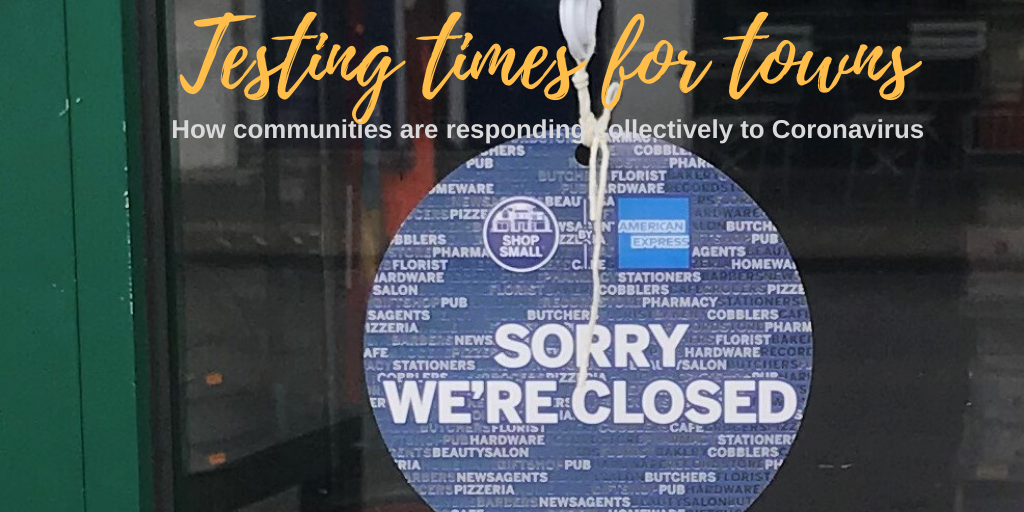
The spread of Coronavirus is adding greatly to the already testing times for our town centres. Times when the role as community hub and the connections created through responsive customer service are being thoroughly tested. The early signs are that amongst the confusion, businesses and community groups are coming together and responding with resolve and creativity.
Sharing what works
Here we begin to look at how the story may evolve and invite other communities to share their experiences and learning. Our experiences to-date have mostly been in small and medium-sized towns with populations up to 30,000. We are though increasingly aware of similar activities in city neighbourhoods. We would love to learn about your experiences of local responses to these testing times for our town centres.
Communities coming together
From our work supporting the future development of town centres, we are aware of communities coming together quickly in creative ways to respond to the Coronavirus outbreak. Through are work in East Suffolk, for example, we know of tremendous examples such as Beccles where the community is coming together using a dedicated Facebook page and telephone helpline to assist in:
- Providing contact details for greengrocers, butchers, cafes, a pet food store etc. that are all able to take telephone orders and deliver items locally.
- Offering social support including a telephone helpline for vulnerable residents.
- Referring residents to social prescribing practitioners to provide advice, assistance and support that takes a holistic approach to people’s health and wellbeing.
After the first week, the group’s Facebook page already had over a thousand followers. Fliers had been published for distribution by volunteers to every household. The fliers offer practical help aimed especially at everyone who is self-isolating for 12 weeks. Importantly, practical tips are being shared between Beccles and other emerging support groups in neighbouring towns. Neighbouring Haleworth has established a Facebook group pulling together information about businesses offering deliveries/take away services. Six miles away in Bungay, the Town Council and Business Association are working virtually as part of the East Suffolk Towns Initiative to plan for the continued revitalisation of the town centre beyond this current crisis.
The BBC reports that volunteer armies helping self-isolating neighbours are springing-up all over the United Kingdom. Facebook has said hundreds of thousands of people in the UK have joined local support groups set up for the virus. Similar groups have been formed in Canada, sparking a trend there known as “caremongering”.
Sustaining existing services
In responding to these testing times for our town centres, it is important to understand the nature of the places, their customers and businesses. Small and medium-sized towns are locally connected places where our research shows over a third of users (34%) normally come into town on foot and where the vast majority of regular customers (88%) will live very locally or travel from within a 30-minute radius. Shopping, especially for everyday items, is the reason for about half of the trips into town. Other activity also provides the lifeblood of these places with over 40% of users also drawn-in primarily to access services or for leisure. The town centre characteristics most valued by customers typically include convenience (89%), customer service (87%) and independent shops (80%). Sentiments important to sustain and develop, wherever possible.
Serving all ages
Around 80% of users visit the town centres at least once a week and 54% spend between £10 and £50 on each visit. It will be important to maintain this connection and spend. Typically, a higher than average number of town centre users will be over 65 (20%). It will be critical initially to prioritise this group that have been identified as more vulnerable to the virus. In these testing times for our town centres though, it will become increasingly important to respond to the needs of all age groups as schools close and the vast majority of residents are asked to say at home.
Adapting everyday essentials
First in-line to adapt to changing needs are the relatively small proportion of town centre businesses meeting everyday needs. These businesses are the ‘essential’ services allowed to stay open according to the most recent Government guidance. These include supermarkets and other food shops, health shops, pharmacies including non- dispensing pharmacies, petrol stations, bicycle shops, home and hardware shops, launderettes and dry cleaners, bicycle shops, garages, pet shops, corner shops, newsagents, post offices and banks. Market stalls which offer essential retail such as grocery and food, can also continue to trade.
Chemists & health products (3%) obviously have a critical role and local communities are rightly prioritising maintaining access to them. Apart from typically small supermarkets, specialist food & drink retailers account for just over 4% of town centre businesses. Such shops are playing an early vital role in adapting to the testing times for our town centres including offering collection and delivery services to vulnerable residents. The Association of Convenience stores has provided very practical guidance on home delivery for retailers covering issues such as how to take payment and operate a collection service.
Maintaining hospitality
The evening, weekend and in some instances the visitor economy, are important parts of the social life of towns centres as well as areas of growth. Cafes/restaurants (8%), bars & pubs (4%) and take-aways (5%) collectively make-up around a further 17% of businesses and face challenging times in adapting to current circumstances. Alongside temporary closures, there is growing creativity with cafes, restaurants and even pubs developing home delivery services. Government guidance sates that such food delivery and takeaway can remain operational. Such moves are aided by the Government’s relaxation of change of use planning rules.
Stimulating wider sales
Particularly challenging are the prospects for many retailers selling comparisons goods such as household items, electrical, gifts and fashion that account for a large proportion of town centre businesses (43%). These are no longer able to open. Whilst individual businesses have shown remarkable ingenuity, customers will become increasingly unable to spend on all but essential goods and during the ‘stay-at-home’ period these businesses can only trade on-line. Local and national interventions will be needed to help stimulate sales.
Likewise, retail services dependent on personal contact such as hairdressing (6.0%) or health & beauty (3%), make-up 9% of high street businesses and also face particularly pressing problems.
Adapting digitally
Though the digital high street has long been on the horizon, it is something that many town centres and individual businesses have been slow to prioritise. With supermarkets seeing a huge search in demand for click and collect during the current crisis, maybe now it should be part of the evolving response during this testing time for our town centres. Our recent surveys of demand for digital services in selected towns, has indicated a strong appetite for development from customers that out-strips businesses’ investments so far. Social media promotion, web site development and targeted marketing were all welcomed as priorities by regular customers.
We are increasingly championing digital marketing strategies for town centres focused on boosting footfall by curating the social media content of up-skilled businesses. Every town has its social media stars to inspire others. We have long loved the work of groups like the award-winning Love Belper who bring these ‘stars’ together to shine more brightly and strengthen the town-wide brand to attract new customers. For the time being such digital development will have to be mentored on-line though arguably businesses have time to focus on this with suitable support.
Experimenting on-line
Kendal in Cumbria is an example of where existing stakeholder groups have come together to link businesses with residents who are isolating themselves from possible infection. As well as a postcard drop to all households and a telephone helpline operated by a local homecare business, the group is also quickly embracing digital by rapidly setting-up a Kendal Shopappy account for an online ordering. Shopappy is a nationally-available, mobile-based app that enables a range of local independent businesses to collectively showcase and sell products or services.
The Cambridge Independent newspaper is working to promote how people can still access local businesses and services during this crisis. It reports how many businesses are innovating by offering deliveries or setting up new digital services and some are teaming up with others to find a way to keep their organisations going. The newspaper is offering a free new app, including the digital edition of the newspaper that provides an A-Z of companies adjusting their services.
Elsewhere town centre businesses are making good use of social media to get their message out. As this blog on selling on Instagram explains, the process recently got a lot easier with the launch of Instagram’s shoppable posts feature. At People & Places we are currently investigating how town centres might best curate such social media content to create an online one-stop shop to address the short-term threat and create long-term opportunities.
Surveys showing business needs
Our survey work indicate that a high proportion of town centre business were already struggling before the Coronavirus outbreak. Over a third (34%) of town centre businesses indicated decreasing annual profitability and a fifth were already expecting turnover to continue to decline in the year ahead. Without business development during this period, the risk is that they will simply emerge weaker and potentially burdened with debt.
FOR Cardiff, the city’s Business Improvement District (BID), has undertaken a business survey as the Coronavirus crisis has begun to take hold. The survey revealed that more than half of city centre businesses are worried that they may face permanent closure due to the outbreak of Coronavirus. Furthermore, 21% said they have already made staff redundancies or are going to make them. In response the Cardiff-based BID is working with national organisations to lobby for support based on evidence of need. Importantly, they are also responding with necessary new developments including a virtual high street Shop Cardiff, to showcase businesses with an online presence and are running a series of webinars covering topics such as financial support.
Stop-gap funding for struggling businesses
Evolving Government guidance on Coronavirus includes links to a new package of support for businesses including pertinently for town centres various scale of business rates compensation:
- small business grant funding of £10,000 for all business in receipt of small business rate relief or rural rate relief
- grant funding of £25,000 for retail, hospitality and leisure businesses with property with a rateable value between £15,000 and £51,000
- a 12-month business rates holiday for all retail, hospitality and leisure businesses in England
- a job retention scheme allowing employers to continue paying up to 80% of salaries for employees’ that would otherwise have been laid off during this crisis
- a self-employment income support scheme providing a taxable grant worth 80% of trading profits
Loans and tax payment delay schemes will be welcomed by many, though for already struggling businesses this may simply be deferring problems. With the duration of this crisis unknown, its is imperative to find ways that businesses can continue to trade to reduce the dependence on such measures.
Tailoring Future High Streets support
Key to making the most of these testing times for our town centres will be dealing with the intensity of the immediate threats. At the same time, it is necessary to have one eye on how a renewed bond between businesses, community and customers can serve our town centres for the future. All this can be accelerated by us all getting better at adapting to local needs and sharing what works between towns in a way that helps the responses evolve.
At People & Places we will apply this is in all our own ongoing work with towns. We believe that this is one of the ways that national regeneration and business networks can add value at this time.
We would like to see developing and sharing good practice in dealing with Coronavirus to be eligible for the early release of funding available through the Future High Streets Fund. Planning for the long-term renewal of our town centres is vital, though this must be blended with the coordinated and collective response to the current crisis.
Find out more
View the introductory video on taking the first steps to town centre recovery and read the accompanying blog here.
Throughout the Coronavirus outbreak we will be sharing inspiring examples and good news stories via our re-invigorated ‘Talk of the Towns’ Facebook and LinkedIn pages.
Read about our work with East Suffolk Council to support long-terms and evidence-led investment in towns centres
For an understanding of how to organise long-term ‘high street’ renewal download a copy of the handbook revitalising town centres: a handbook for council leadership edited by the People & Places Partnership for the Local Government Association.