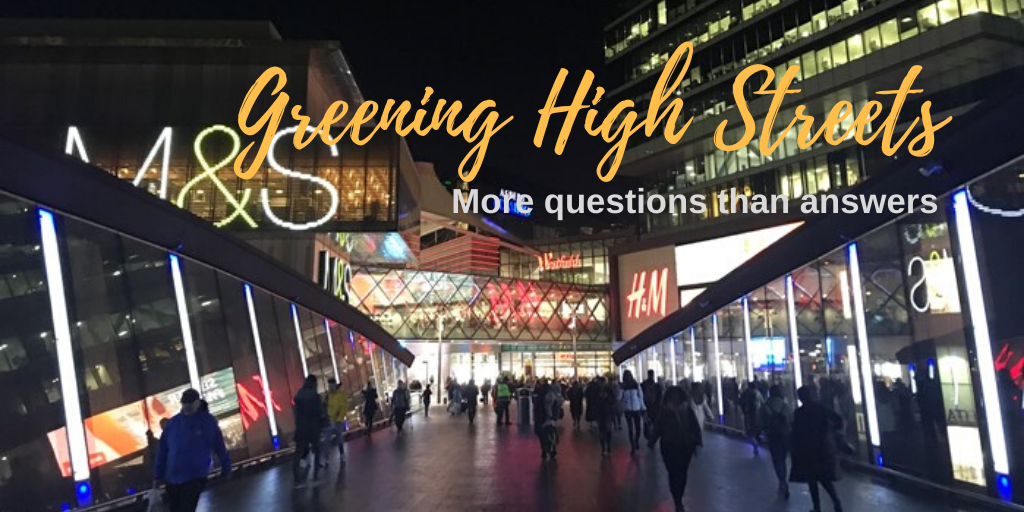
Amongst all the other challenges facing our town and city centres, can we afford to care about greening High Streets? As ATCM’s Chief Executive, Ojay MacDonald promised in his introduction to this week’s conference titled Green High Street 2050: A Climate Emergency, its a topic that poses more questions than answers. Questions about greening High Streets that multiplied for me as, homeward-bound, I changed trains in the evening shadow of Westfield Shopping Centre.
Here are some of the questions about greening High Streets that I took-away from the conference and partial answers that I am left with about why town centres and their stakeholders should care and start responding now to the climate emergency.
Considering co-benefits
It’s probably inappropriate to use the analogy of ‘killing two birds with the same stone’, though you get the gist! If action to reduce climate change brings other local benefits, then the case is made more persuasive. Imperial College’s Grantham Institute provides a great briefing paper & short animation of how action on climate change can help to address other issues that also matter to the UK public. A good example is how encouraging cycling and walking has a lower carbon footprint, can alleviate local pollution and brings health benefits.
Looking to planners for joined-up thinking
Joined-up action for climate change in town centres is complicated; think of balancing the impacts of brown field developments with transport infrastructure needed to serve greenfield sites. Planners love weighing-up such considerations and guidance such as the Royal Town Planning Institute’s (RTPI) 2018 Planning for Climate Change pulls together thinking at a policy level. Watch-out for updated guidance as the impacts of the Government’s 2019 commitment to bring all greenhouse gas emissions to net zero by 2050 cascades through the planning system.
This week’s Court of Appeal decision that plans for Heathrow’s third runway are unlawful, shows the importance of being able to demonstrate joined-up policy. At a more local scale, RTPI research shows planning is not fully delivering sustainability with, for example, only 20% of recent housing permissions being within 800m of a train station.
Following the money
The thought-provoking post-lunch pitch for sustainability from New Look as a major High Street retailer, was that capitalism will provide many of the answers. The business case for sustainability is that it can attract new customers; enhance brand equity and reputation; lead to improved processes and efficiency. Achieving sustainability and going beyond ‘greenwashing’ involves addressing sourcing of materials; supply chains; people and culture; and the circular economy (designing out waste and pollution). Authentic and industry-wide accreditation standards can help strengthen the case for sustainability within companies and reassure customers.
A practical example cited of how sustainability makes such business sense, is the way New Look and Hospice UK are working together to encourage customers to donate their pre-loved clothes to charity shops, so that they don’t end up in landfill. In return, customers receive a 20% off New Look voucher.
Understanding new consumers
Research shared by ATCM’s partner Kids Insights, shows that 35% of older teens (16-18s) state that the environment is their top concern and just over 60% think about their personal effect on the environment. This converts in to 10% who like brands which are ethical and, alongside around 80% of all kids who are confident of their pester power, indicates the potential pull of these new consumers. Whilst it seems that shopping habits are formed at an early age, the downside for local high streets is the indication that teens’ needs are not currently being met, with only 16% liking the range of available shops and just 8% believing that town centres provide good places for them to hang out.
There is also evidence that attitudes are changing amongst older consumers: the most recent version of the IPSOS Mori Issues Index shows that pollution and the environment has risen to the third most important issue for the UK adult population
Mainstreaming green town centres
The Green High Street conference, the currency of climate action and a six-month old Government pledge to achieve net zero, leave me thinking now is the time to mainstream greening our town centres. Long-rehearsed platitudes like, “think global; act local” have not been widely persuasive. We need a more sophisticated understanding of the arguments for action to reach beyond the already converted. It is the time to redefine the questions and look for more persuasive and practical answers. Get this right and it puts our town and city centres at an advantage.
As our own business, we will be weaving an added understanding of climate action into our stakeholder analysis of town trends, action planning and our other specialities at People & Places. As ever, we will share formative thinking through our ‘Talk of the Town’ network. Through our continued involvement with the Association of Town and City Management (ATCM) and alongside other Institute of Place Management (IPM) Fellows, we will look to learn from others and seek to keep finding answers. Download a copy of the Revitalising Town Centres Handbook which People & Places developed for the Local Government Association (LGA), to read about the joined-up approach that we advocate for turning-around towns.
What are your organisations’ questions about greening high streets? Better still, do you hold some of the answers?