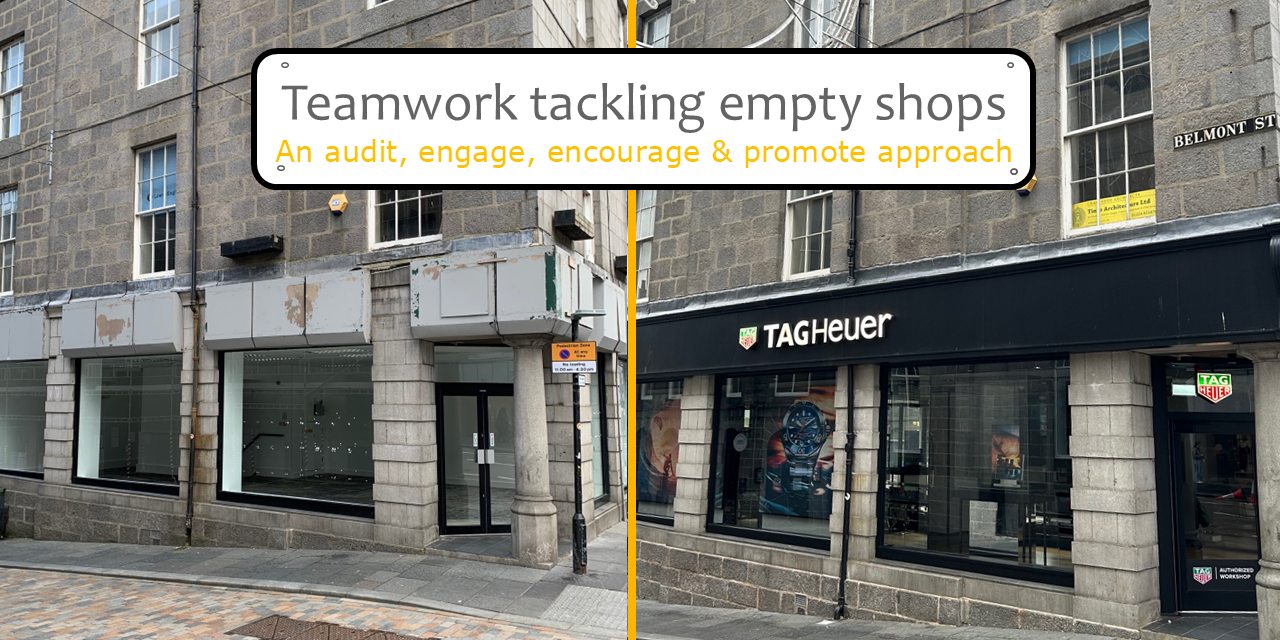
Guest blog about teamwork tackling empty shops, by Iain Nicholson MIPM, founder of The Vacant Shops Academy.
Why don’t you set a target of reducing high street vacancy in your town or city centre by half in 18 months? Impossible…?
What if you learned – as you will from the accompanying ‘Tackling High Street Vacancy’ guide – that one city has just done exactly that, and that other very different places, in varied circumstances and times went further through teamwork tackling empty shops?
Working with range of vacancies rates
If your place has vacancy in the mid/high teens per cents or more than 20 per cent, I’d encourage you to have a read and follow the approach.
Even if your place has lower vacancy rates but seems stuck with a small number of tricky, maybe large, prominent and deteriorating empties, you’ll see how the same methodology could work for you. Or maybe you are seeing units let but mostly to use types that don’t really add to your current mix.
Based on two ideas
It’s based on two ideas.
One that tackling vacancy is more than ‘just an agents-landlords thing’ and that a ‘place partnership’, bringing together businesses, community, cultural organisations, councils, chamber, BID where there is one, can get the job done quicker and more sustainably.
The other is that while retail, hospitality and services still have a part to play, you can now look to a much longer list of go-to options to fill those empties: arts & crafts, creative, culture, community, history & heritage, leisure, education, health and health & wellbeing. With residential and office among the possibilities for un- and under-used upper floors.
Audit, engage, encourage, promote
The approach that the guide describes – we’ve called ‘audit, engage, encourage, promote’ – starts with getting an accurate picture of your vacancy situation and understanding the barriers to bringing those empties back into play.
It then sets the ‘place partnership’ (or town team if you prefer) on a proactive strategy to overcome those barriers with each of the stakeholders – including every part of your community – playing their role.
It might involve a pop-up shop project, some splitting of bigger units, a grant scheme to help with the costs of getting empties into shape, a raft of placemaking initiatives to have the place looking the best it can be and adding to events, street art, promotion, travel options and the like.
It will also involve a proactive approach to identifying use types and the businesses and organisations within that which will add to your mix and going out to ‘encourage’ them to take up space.
Bringing partners together
Quickly you’ll see why the ‘place partnership’ is crucial. On their own, individual stakeholders may struggle to move things at all, never mind in a way that makes a positive difference.
The commercial property market – though it will do much of the heavy lifting on lettings – has its flaws which can mean vacant units aren’t even being marketed much less unlocked for new occupiers. The guide sets out some of the ‘why’ in more detail.
Councils and BIDs can have capacity, resource and responsibility challenges when it comes to this issue.
Businesses and community may be keen to get involved but are time limited or lack expertise in the practicalities.
Together though, as a number of places are proving, it’s different.
Testing with pop-ups
Take a pop-up shop project as just one example of how it works.
The council or BID or one of the specialist organisations in this field can take on the lease (or licence) on a vacant unit with options to sub-let to a list of occupiers.
A grant scheme can help get the space ready to use.
Your existing businesses and community can help identify use types that would add to the mix and may be pop up candidates themselves.
Agents and landlords can combine to make a unit (or better still a number of them) available and use their expertise to facilitate agreements.
From pop-up to permanent presence
The previously empty, possibly untidy, unit looks better, is fit to occupy and has a business or organisation or maybe several operating from it. They’re getting a realistic test of being on the high street, the confidence that they can do it and a track record they can present to future landlords. Very often we’ve seen pop-up businesses become long term tenants after their trial run, sometimes in the actual unit they started in.
Having one or a small group of units back in play improves the look and attractiveness of the place and helps build momentum that gets other units let and so on.
And this is just one project of many a tackling vacancy-focused ‘place partnership’ can deliver that takes you towards your target.
Link to wider challenges
Where there are challenges, you’d benefit from additional support with, there are specialists with strong track records who can help. If this includes maybe engaging and involving your community in a structured way, then the revitalising town centre toolkit produced by People & Places for the Local Government Association is a great starting point. Equally they can help you to do more to bring potential customers from ‘sofa to the shop’ by maximising active travel to town options, enhancing the welcome and route around town on arrival.
Proven partnership approach
It’s all part of a proven partnership approach to tackling vacant shops amongst the wider revitalisation of town and city centres. We know it works and how to tailor that to varying places in different circumstances and with available skill sets locally. The Vacant Shops Academy has shown this by working across 33 locations and adding more all the time.
For further information
Read the review of the ‘Tackling High Street Vacancy’ guide in our Recommended Reads section of the People & Places’ Ideas Library.
Take a look at the guide and get in touch directly if you’ve any questions or think we can help further: iain@prbi.co.uk