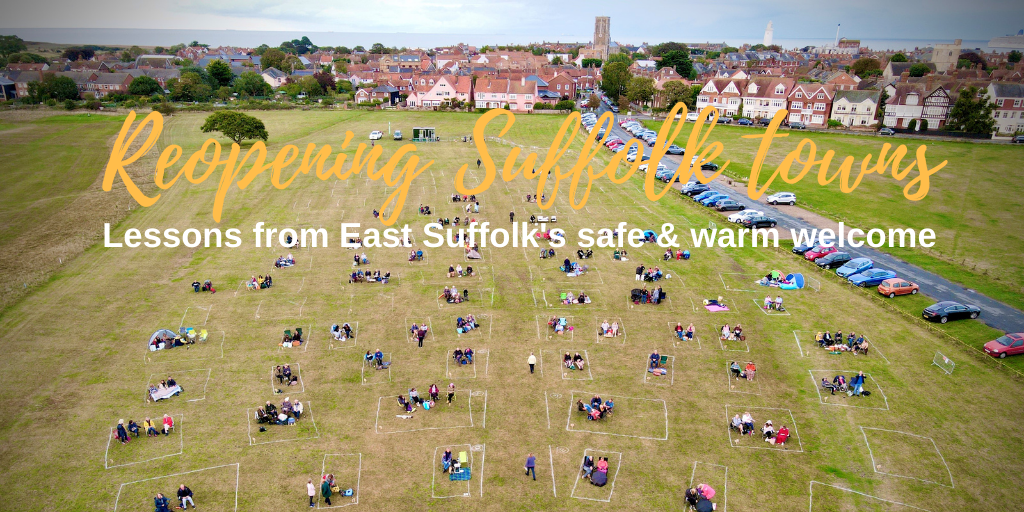
At times there are very polarised opinions expressed about choosing between wellbeing or the economy in responding to the COVID-19 pandemic. This is obviously heightened as England experiences a second lockdown and many town centre businesses close again. We have much to learn though, from how communities and businesses responded positively with a safe and warm welcome-back to town in summer 2020.
Balancing “health and wealth”
At a practical level in our town and city centres, our experience at People & Places is that communities and businesses instinctively realise the importance of balancing “health and wealth” on the high street. One way where we saw this happening as town centres reopened over the summer, was through our work supporting town partnerships in East Suffolk. This large district has a population of over a quarter of a million that is normally greatly boosted by seasonal visitors. It is centred on 12 towns between Felixstowe in the south and Lowestoft, 50 miles to the north.
Spotlight on East Suffolk’s town centres
The data for East Suffolk, like many areas, indicated the vulnerability of businesses post-lockdown. A COVID-19 tourism economic impact assessment prepared for East Suffolk Council in June, suggested that the local visitor economy was set to lose £251 million in 2020 (37% of annual total) as things stood. Responses from a July survey of East Suffolk small business indicated that 53% were still not trading and 20% were unlikely to survive less than 6 months under current conditions.
Understanding customer concerns
Local businesses in East Suffolk, as elsewhere, intrinsically understood the combined benefits of welcoming customers back to town in a safe and inviting way. This is a sentiment consistently reinforced by national trends showing that that the summer began with over half of the population reluctant to go into shops, and nearly three-quarters avoiding crowded public spaces.
Accelerated issues and learning
A fashionable phrase that was banded about since summer 2020, is that the COVID-19 pandemic has “accelerated current issues” faced by high streets and the need for learning. We agree with this in-part. COVID-19 has hastened the need for responsive action planning to tackle town centre issues to a pace perhaps previously unimagined. It has also emphasised the need for capable partnerships of businesses and the wider community, able to help communicate and coordinate a joined-up response.
Delivering practical improvements
Approaches such as that articulated in the East Suffolk COVID-19 recovery plan, demonstrate how county, district and town councils, have worked with business groups to respond to the pandemic. East Suffolk Council has facilitated recovery across its 12 towns by delivering national good practice and locally-targeted practical improvements. These improvements have included:
- In Halesworth and Felixstowe, traffic restrictions were introduced at busy times in close consultation with business owners and the wider community.
- Framlingham and Beccles markets were helped to continue trading safely thanks to signage, hand sanitisers and temporary barriers to allow social distancing.
- In Woodbridge, the town’s market place was used for outdoor tables and seating for adjacent cafes and a pub in a way that help creates a new attraction.
Forging new partnerships
The East Suffolk recovery plan also advanced partnership working that promoted the necessary communications and coordination between business and community groups to get things done. Local examples of such a forging of new ‘can do’ town partnerships during the pandemic has included:
- A Lowestoft recovery & revitalisation checklist was prepared by key partners to join-up opportunities for turning-around the town centre and adjoining areas.
- The business group in Woodbridge has been helped to promote its ‘Stay Local, Choose Woodbridge’ campaign highlighting community and traders’ activity.
- In Felixstowe, the bringing forward of plans and a ballot to create a new Business Improvement District to boost business support, marketing and accessibility.
Wider messaging
It is important to back-up town-based progress with wider messaging. To reinforce messages about the safe and warm welcome to town centres, East Suffolk Council has launched a marketing campaign around the themes of ‘shop local’ and ‘stay safe’. Meanwhile the East Suffolk Smart Towns project is building on increased customer and business demand for digital development.
Southwold’s advancing good practice
Within East Suffolk, Southwold is an example of a town that has been able to advance its partnership development and project delivery during the pandemic. Following earlier studies providing an evidence-base of long-term issues undermining business confidence, Southwold Town Council appointed a Town Development Manager in April 2020 as the pandemic took hold. Such decisiveness enabled a coordinated response in reopening the town centre in a way that underpins its long-term revitalisation. Initial activities included:
- stakeholder engagement & strategy
- managing streetscape, public realm & access to businesses
- recruiting town ambassadors
- developing the ‘My Southwold’ brand
- creating unique and sustainable events such as open air film festival
- developing a digital window shopping initiative during the second lockdown
- pursuing future projects & priorities with stakeholders
- forming a business association
Impressively, 75% of the towns’ businesses agreed that the newly introduced pedestrian one-way system was working well and over 80% said they would join a new Southwold business association.
Adapting to future challenges
There is no doubting that 2020 has been incredibly challenging for town centres, their businesses and communities. People have suffered real hardships; businesses have failed and sadly lives have been lost. Further challenges remain in the months ahead.
Communities and their businesses across areas like East Suffolk, can, however, be proud of how they have come together, adapted and learnt in providing a safe and warm welcome-back to town in summer 2020. The responses have not been universally successful, whilst resources have been stretched. In testing times, though, we have seen an acceleration in activity and a forging of new partnerships with ‘can do’ attitudes that bode well for the future. As much as ever, we are reminded that the wider wellbeing of local people and the prosperity of the places they enjoy, are both inextricably linked.
More information
You can read the full LGA case study on reopening East Suffolk or watch the video on reopening East Suffolk’s towns to see some of the activity that has taken place to create a safe and warm welcome-back to town.
To get an understanding of the process being followed across East Suffolk, you can access the Local Governments Association’s revitalising town centres on-line toolkit which includes practical guidance on post-COVID 19 recovery planning. You can also read other case studies in the LGA series on town centre recovery and revitalisation editied by People & Places including: Leamington’s safe & welcoming reopening; Solihull’s place leadership; tracking Nuneaton’s footfall through the pandemic; reopening hospitality in Westminster; and reopening & revitalising Selby.
For up-to-date information on how town partnerships can respond to the COVID-19 crisis, keep an eye on the beyond COVID-19 page of this web site, which has recently featured posts on managing streets and public spaces in 2020 and tracking national trends in adapting for recovery.