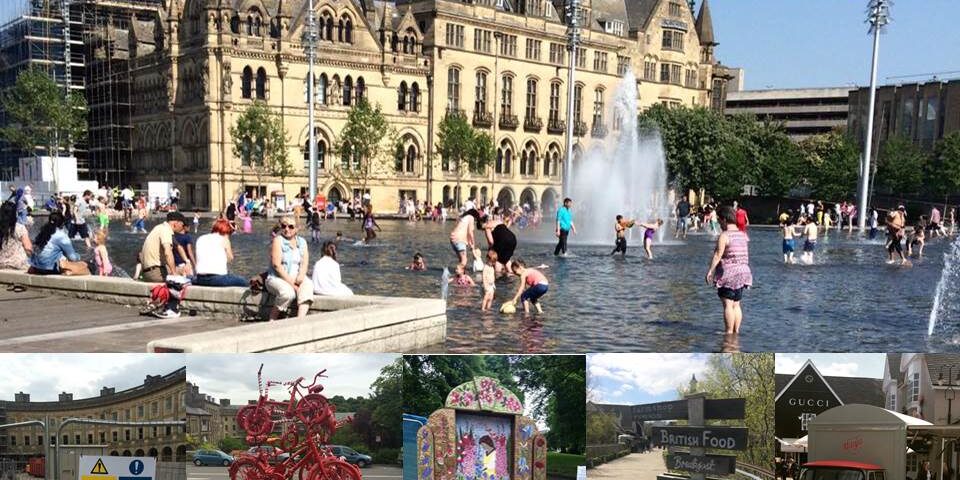
What turns a town or city centre in to a destination for visitors? And what even is the attraction of becoming an attraction?
Those are some of the thoughts that went through my head recently as I have toured three town and city centres going through different transformations in the hope, partly, of putting themselves on the map.
Lessons from Bradford, Buxton and Bicester
Bradford, Buxton and Bicester are three very different places that are going through different changes to boost their local economies and bounce back. All share rich histories, stunning architecture and though each has perhaps lost its way over recent decades, are now investing to change that.
On a recent weekend trip to Bradford, I saw a city renewing itself on several fronts: The creation of the new Broadway Shopping Centre gives a bright base for multiples more befitting the city’s size; restoration and conversion of Little Germany’s magnificent mills provides desirables homes and businesses bases; the City Park in front of the splendid City Hall hosted a Sky Ride and family paddling on consecutive days during my visit; and the North Parade is being nudged to define itself with Bohemian bars and eateries. It is a work in progress to join all this up and fully animate the city centre to attract more visitors but it shows impressive intent.
Bicester has seen comparable investment relative to its scale over recent years. The development of a new Sainsbury’s, large multi-storey car park, restaurant chains and small retail units around Pioneer Square has greatly increased the town centre’s offer whilst last week saw the official opening of a laudable library complex to boost its offer for the surrounding communities. Plans are afoot to improve visitor orientation around the town; especially for the infrequent visitor. Bicester Village outlet centre lies to one edge and provides lessons to us all on how to develop a national destination and make the visitor welcome –if somewhat soulless for my tastes.
Buxton obviously has a national brand and profile through its spa water but will benefit from a big boost when the £50million restoration its Georgian Crescent and Thermal Spa will be completed in 2017. The restored centre piece to Buxton’s rich architecture will provide a new indoor attraction for day visitors, schools and tourists as well as raising the town’s status as a destination within the wider Peak Park. The challenge will be to spread these benefits by increasing footfall around the rest of Buxton’s split-level town centre.
Important questions
Two gatherings of towns folk that I attended this week raised important questions about the focus of towns in seeking to become visitor destinations: Discussions in Bicester this week at a gathering of Oxfordshire towns ably led by Professor Cathy Parker from the Institute of Place Management, questioned whether too much priority is given to turning towns in to destinations when being a good, local service centre can offer year-round stability. Equally, discussions facilitated by Jean Ball at the Derbyshire Town and Business Forum highlighted the importance and value provided by festivals and events -and not capital spend- in changing perceptions about a place and attracting new visitors.
Getting the basics right
Our own experience at the People and Places Partnership, points to the value of getting the basics right to create a positive first impression. If a town or city centre does not first meet local requirements, then it risks at best becoming a place where you can “get everything you want; and nothing that you need”. Equally, fail to get the basics right and visitors will neither linger nor return.
Our national benchmarks indicate that in struggling small town centres, businesses will be most negative about car parking (54%), although customers will be equally critical of the retail mix (54%) ahead of parking (43%). Our audits of customer journey experiences in towns nearly always indicate a need to improve signage and orientation for visitors as well as pointing to ‘quick wins’. Certainly that was my quick first impression for Bradford, Bicester and Buxton, where there were challenges in directing uninformed visitors between different central sites. Get this right though and we believe that some town and city centres can aspire to serve both the needs of locals and the expectations at least of incidental visitors who are enthusiastic to be entertained. Like local shops; hotels and guest houses need a towns attractions to be apparent year-round.
Community connections
Festivals and events we agree can help boost footfall at least temporarily but it’s important to think about the connection to the place in terms of timing, location and appeal to the local community. Bradford seemed to be getting this right with its City Park events. A town fair, school prom and theatre night in evidence on my trip to Buxton, suggested a lively, local mix too. Again, it’s also important to get basics like parking, toilets and refreshments right to help the events happen and create a positive and lasting impression.
Physical changes, along with events, can begin to alter people’s perceptions about a place though we firmly believe that this starts with the local community. In our book, a town or city’s identity is firmly rooted in the experiences and attitudes of local people. How, for example, does Bradford capture its industrial past and multi-cultural present in a way that is apparent and appealing to the potential visitor? What is unique about Bicester to distinguish itself from other Oxfordshire towns and the shallow perfection of an outlet village that has stolen its name? Only if this local identity is fully assessed and properly understood, can we hope to reflect it in a true brand that can be tailored for different audiences.
Further reading:
An introduction to our national benchmarks used as an evidence base for understanding customers’ needs, can be found on the Great British High Street web site:
Copies of a ‘customer journey checklist’ template used to improve signage and orientation for visitors can be downloaded for free from the Free Tasters section of our web site.
An overview of good practice in town centre car parking and access review including the ‘Between the Lines’ approach to locally-led car parking strategy can be found on the Top Tips section of our web site.