
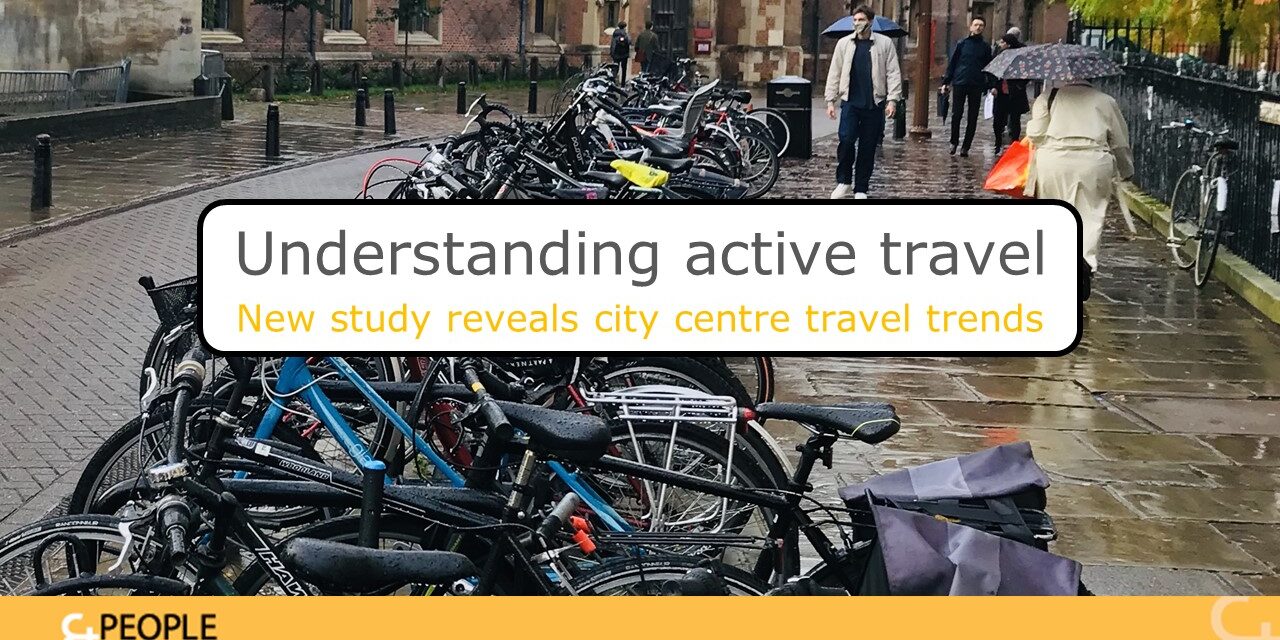
A comprehensive biennial study published last week provides a key focus for understanding city centre active travel trends and how we can boost opportunities for people to visit and enjoy the U.K. and Ireland’s High Streets.
The UK Walking and Cycling Index aggregated report was published by Sustrans at the end of March. It helps inform local decision-making by providing detailed evidence gathered from 23 urban areas, or index cities, from across the UK and Ireland. It uses the term ‘wheeling’ alongside walking and cycling to ensure that wheelchair and mobility scooter users are included. It features data collected in 2023 and is comparable to earlier studies including the previous index published for 2021.
Here, to help in place leaders in understanding city centre active travel trends, we pull-out what we believe to be some of the key data in this comprehensive report and compare it with our previous review of the report covering 2021. We do not do this to evangelise about the benefits of active travel though rather seek to present objective facts to inform understanding and decision-making by place leaders.
The importance of walking and wheeling
The first point to come out of the data is not to under-estimate the importance of walking and wheeling within wider active travel.
- More people walk or wheel five or more days a week than any other mode of travel (49%). This compares to 50% in 2021.
- 7 billion walking and wheeling trips were made in index cities in the past year.
- 69% of residents think their local area overall is a good place to walk, compared to 74% in 2021.
- the most popular purpose for walking is to reach a particular destination, e.g. work, shopping (51%), followed by enjoyment or fitness (42%), compared to 53% and 39% respectively in 2021.
- 80% of residents would be encouraged to walk if there were more shops and everyday services, such as banks and post offices, close to their home. The same as in 2021.
- the most popular change to encourage residents to walk more is to create nicer places along streets to rest (78%) -compared to 80% in 2021. This followed by better pavement accessibility such as level surfaces and dropped kerbs (74%) as opposed to more frequent and quicker road crossings in 2021 (73%).
The report uses a 400m straight line, equivalent to a 5-to-6-minute leisurely stroll, as a benchmark for assessing the proximity of services. Under this criterion the number of people living within easy access of services was parks or recreation spaces (92%); cultural and leisure venues (75%); and food shops (65%).
Opportunities to increase the role of cycling
With an estimated 1.99 billion journeys of up to 3 miles (approximately 5km) driven in the index cities alone each year, it is important to consider the opportunities to increase the role of cycling in extending the active travel reach.
- Only 15% of people cycle regularly (at least once per week).
- 6 million cycling trips were made in index cities in the past year.
- 290,000 return cycling trips are made daily in index cities by people that could have used a car.
- only 44% of all residents think their local area overall is a good place to cycle -compared to 42% in 2021.
- the most popular purpose for cycling is work (34%), followed by shopping, personal business and social trips (33%); and leisure (17%). This compares to 33% for work and shopping in 2021, and 25% for leisure.
- 10% of residents perceive themselves as cycling regularly; 18% occasionally; 5% new or returning to cycling; with 28% saying they do not cycle but would like to. This is very comparable to 2021 figures of 10%, 18%, 5% and 30% respectively.
- the joint most popular personal improvement to encourage cycling was access to secure cycle storage at or near home and access to a bike (53%); followed by access or improvements to a city cycle sharing scheme (47%). This compares to 55% jointly and 49% respectively in 2021.
- the most popular infrastructure investment for encouraging more cycling was more traffic-free cycle routes away from roads, e.g. through parks or along waterways (67%); followed by better links with public transport, like secure cycle parking. This compares closely to 69% in favour of more traffic-free cycling in 2021, followed by more cycle tracks along roads that are physically separated from traffic and pedestrians (65%).
- across the index cities, there are 1,555 miles of traffic-free cycle routes away from roads and 155 miles of cycle tracks physically separated from traffic and pedestrians.
- only 20% of households are within 125 m of at least one type of these routes or signposted alternatives on quiet roads
Inequalities in walking, wheeling and cycling
Walking, wheeling and cycling participation is not always equal.
- the gender gap has narrowed slightly with the proportion of the population who cycle at least once a week now 10% of women and 21% of men -compared to 11% and 23% respectively in 2021.
- the proportion of residents who cycle at least once a week by socio-economic group is 19% of AB and 11% of DE -compared to 22% and 11% in 2021.
- the social inequality has narrowed for pedestrians with the proportion of residents that feel welcome and comfortable walking, wheeling or spending time on the streets of their neighbourhood now 53% for socio-economic group DE, compared to 64% for socio-economic group AB -this compares 55% and 74% respectively in 2021.
- The proportion of people who cycle regularly, does noy vary greatly with age amongst the working population with all age groups from 16 to 65 within the range of 15-18%. It does tail-off over 66 to only 5%, though this is a broad age category.
Balancing walking, wheeling, cycling and driving
The survey findings suggest a recognition by residents of the need to rebalance the opportunities to travel into town other than by car.
- 60% agree increasing space for people socialising, walking and cycling on their local high street would improve their local area -compared to 63% in 2021.
- only 29% of residents think that their streets are not dominated by moving or parked motor vehicles -compared to 26% in 2021.
- residents would find fewer motor vehicles on their streets useful to enable them to walk more (62%) and cycle more (59%) -compared to 66% and 62% respectively in 2021.
Trends in usage between places
Individual reports are available on the Sustrans web site for each of the individual cities and sub-regions. There is also a very helpful and easy to use walking and cycling index data tool that makes it possible to explore the data and compare the use and attitudes within places and different demographic using interactive dashboards. Here we use this to draw-down on some of the data on two areas we know well as the People & Places Partnership: Greater Cambridge and Tyneside.
- The proportion of residents who cycle at least once per week is highest in Cambridge (45%) and more typical in Tyneside (14%) compared to all cities surveyed (15%).
- The proportion of people who most frequently walk, wheel, cycle or use public transport to reach a food shop or café within their neighbourhood varies from Cambridge (45% or 51%); Tyneside (38% or 44%); and across indexed cities (39% or 42%). Dublin (52% or 61%) and Tower Hamlets (65% or 54%) have the highest proportions of residents using sustainable transport compared to the lowest proportion in Inverness (31% or 27%)
Trends in perceptions between places
- The proportion of people who think that their local area is a very good place to walk or wheel are Cambridge area (38%); Tyneside (32%); index-wide (30%). Bristol (26%) has the lowest percentage and the Dublin metropolitan area (45%), the highest proportion.
- For cycling it is a less positive case with the proportion of people who think that their local area is a very good place to cycle being reduced to Cambridge area (18%); Tyneside (12%); index-wide (12%). Bristol (again), Southampton and Greater Manchester (10%) have the lowest percentage and the Dublin metropolitan area (26%), the highest proportion, again. Combining very good and good responses, Cambridge (65%), is only bettered by Dublin (66%).
Trends in requirements between places
- There is a consistent level of recognition between places about the importance of encouraging walking and wheeling by reducing traffic, with responses rating this as very useful equivalent to a third of people (28-39%) from all cities, compared to an average of 35%.
- The relatively modest investment in creating places to sit and rest would be considered very useful in improving walking and wheeling by a moderate proportion of users in Cambridge (33%) and a higher percentage in Tyneside (47%), compared to all cities surveyed (51%).
- There is a consistent level of recognition between places about the importance of encouraging cycling by reducing traffic, with responses rating this as very useful equivalent to broadly a third of people (28-38%) from all cities and comparable to an index average of 33%.
- Whilst there were slightly higher calls for cycle routes away from roads or segregated from traffic, there were also relatively high calls for the more achievable option of more cycle routes along quiet roads being very useful including in the Cambridge area (45%), Tyneside (33%) and across all cities (38%).
Trends over time
- Between 2019, 2021 and 2023 the proportion of people who cycle at least five times per week has fluctuated in a downwards direction in both Cambridge (29%, 19%, 23%) and Tyneside (4%, 5%, 3%).
- The proportion of people who walk or wheel at least five times per week has steadily increased in Cambridge (50%, 54%, 56%) and stayed almost constant in Tyneside (5%, 49%, 49%).
Informing future town centre research
At the People & Places Partnership, we will be using the Walking and Cycling Index data to inform and benchmark our revitalising town centre baseline studies and the growing number of travel and access reviews that we are commissioned to undertake for neighbourhoods, towns and cities. It is very valuable to have such objective insights about perceptions, use and potential improvements to cycling and walking as part of the travel mix that can enable people to access and enjoy town and city centres.

