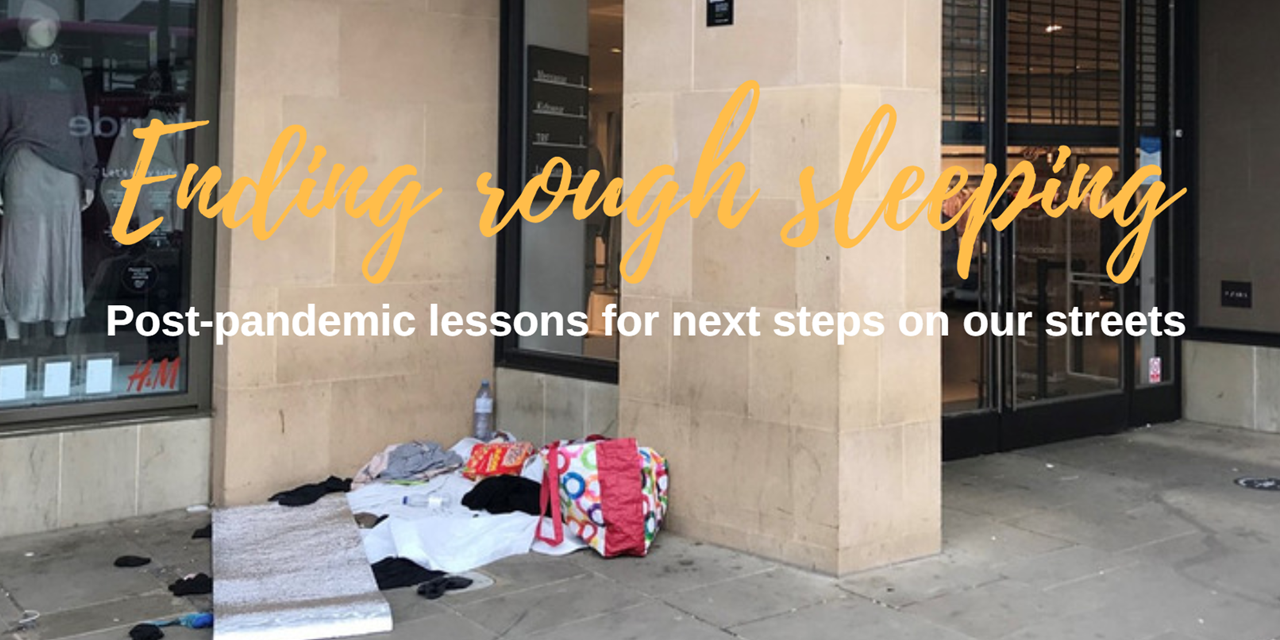
One of the good news stories to emerge during the COVID-19 pandemic was the temporary reduction in rough sleepers. As our town and city centres reopen, what are the prospects for capturing the learning and taking post-pandemic steps for ending rough sleeping on our streets?
Rapid progress during pandemic
As the charity Crisis reported in its annual Homeless Monitor for 2020, the pandemic prompted a radical and rapid nationwide shift in responses to extreme forms of homelessness with a remarkable degree of success and speed. Through the ‘Everyone In’ approach, over 90% of rough sleepers known to local authorities at the start of the pandemic were rapidly offered accommodation including in hotels and holiday lets. By January 2021, over 36,000 people had been assisted in this way, with 26,000 of them helped to move into ‘follow on’ accommodation.
Understanding rough sleeping’s complexities
Crisis defines rough sleeping as the most visible and dangerous form of homelessness. Rough sleeping should be considered as a distinct issue from on-street begging and other forms of anti-social behaviour, although there is some cross-over.
The longer someone experiences rough sleeping for, the more likely it is they will develop additional mental and physical health needs, substance misuse issues and have contact with the criminal justice system (collectively known as complex needs). The more complex needs someone has, the more help they will need to move on from homelessness and rebuild their lives.
Personalised responses
Many people who experience rough sleeping struggle to access the support services they need. For example, if someone has both a mental health and drug or alcohol problem, they can often be refused help by both mental health and substance abuse services until they have addressed either issue.
Getting people into appropriate accommodation quickly is important. Rough sleeping can be prevented if services work together to identify people at risk and move people off the streets as quickly as possible. The No Second Night Out (NSNO) model is used by many local authorities to move new rough sleepers into accommodation.
In many areas, the lack of appropriate accommodation acts as a barrier for getting people off the streets. Crisis believe that the government should invest in a range of settled housing solutions to prevent rough sleeping occurring. Crisis has published research that shows the effectiveness of different housing models and services for rough sleepers and people with complex needs including international evidence review of what works.
Existing government approach
Prior to the pandemic, the government’s Rough Sleeping Strategy, published in 2018, committed to taking steps for ending rough sleeping by halving numbers by 2022 and ending it by 2027. The strategy stated that achieving this ambition will require central and local government to work collaboratively and innovatively with business, communities, voluntary groups and the general public.
Cross-government working was considered essential in preventing and relieving rough sleeping, as well as ensuring that ill-health is not a cause of or barrier to, people moving away from rough sleeping. At a local level, this involves collaboration between the NHS, local authorities, social care and housing services.
The role of place managers
Place managers in our town and city centres often find themselves at the forefront of the rough sleeping crisis locally and have to respond to businesses’ and customers’ concerns. The most recent version House of Commons Library briefing paper on Enforcement Powers in relation to rough sleepers, sets out an armoury of powers that local authorities and place managers can use. The briefing recognises that rough sleeping is often associated with nuisance activities such as begging, street drinking and anti-social behaviour that can have a negative impact on local communities. It also acknowledges, however, that homelessness organisations are concerned that the use of these powers criminalises rough sleeping and does not address the root cause of the problem.
The Association of Town and City Managers through its ‘Have a Heart Give Smart’ Campaign similarly recognised that as the issues around rough sleeping and associated anti-social behaviour are complex, they require a multi-dimensional approach which includes educational, health, business, police, local authorities (various departments) as well as other community responses. One of the campaign’s key messages is that it is ok to say ‘no’ to the direct giving of money to the homeless/rough sleepers/street beggars. Instead, the campaign advocates creating a central pot for monetary donations to be made within the town/city centre such as a local, registered homeless charity.
Learning & long-term impacts
The National Audit Office (NAO) published a report on its investigation into the housing of rough sleepers during the Covid-19 pandemic in January 2021 which identified several actions Government needs to address if it is to achieve the goal of ending rough sleeping including: fully understanding the needs and scale of the rough sleeper population; moving people on from emergency accommodation; aligning the initiatives and funding streams announced during COVID-19 into a cohesive plan.
As Crisis has recently reported in its annual Homeless Monitor for 2021, progress during the COVID-19 pandemic provides an opportunity for defining the next steps for ending rough sleeping. This will include reviewing the future role of dormitory-style shared sleeping accomodation and determining effective move-on arrangements for people temporarily accommodated during the pandemic. Crisis concludes that steps will need to be taken to address the institutional and individual causes necessary to stem a potential tidal wave of ‘new’ homelessness expected as a COVID19-induced recession potentially takes hold.
Swimming, running & riding for rough sleepers
Find out how People & Places Director, Chris Wade, in swimming, running and riding to help rough sleepers has raised funds for two long-established homelessness charities.
For 25 years, Jimmy’s has been providing help to people experiencing homelessness in Cambridge. Jimmy’s works with local people, communities, organisations, and partners to deliver 24/7 emergency help, support and accommodation for those who would otherwise be sleeping rough.
Crisis was formed in 1967, as an urgent response to the then growing homelessness crisis. Since then they have helped tens of thousands of people out of homelessness, and campaigned for change.