
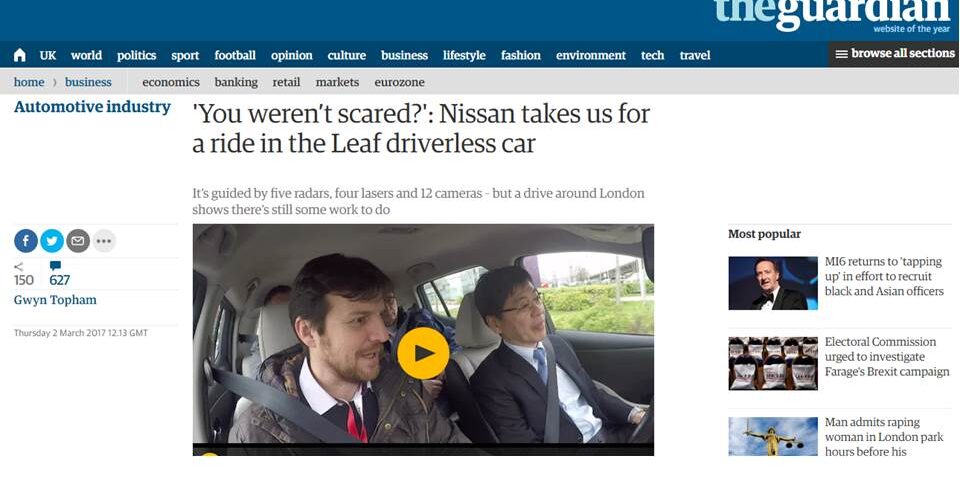
Should we be scared?! As Nissan tests its autonomous vehicles on London’s streets, does the advent of driverless cars raise questions about town traffic? Here we review the likely impact of this and other smart travel innovations and ask what can be done locally to influence positive progress.
Low Emission Vehicles: Predicted as one of the most rapid changes in transport on UK roads; their local impact is most likely to be in improved air quality.
Smart Parking: If managed effectively, enhanced use of technology could bring some of the most significant, short-term impacts on town centre travel including improved convenience, costs and congestion.
Cycling and Walking: Though seemingly low-tech alternative solutions, well-targeted improvements could increase convenience and reduce costs for customers as part of wider travel strategies.
Shared Space: Shared Space is an approach to street design where all traffic control devices, markings, curbs and signage are removed. The approach can ease congestion and improve convenience but schemes need to be carefully designed.
Vehicle Sharing: This covers different ways a car can be shared by users. More widespread vehicle sharing could offer improved convenience, congestion and cost though take-up will be hugely influenced ‘carrots and sticks’.
Integrated Transport: An effective integrated transport system enables passengers to easily switch between modes of transport. Potentially this will increase convenience and reduce cots though levels of take-up will be dependent on local investment in ‘soft’ and ‘hard’ infrastructure as well as the comparative costs of journeys.
Intelligent Mobility: This is the hidden innovation that will be behind so many improvements to transport service in and between our towns and cities. It will be important that local initiatives are ‘plugged in to’ major, global advancements to increase convenience, reduced congestion, moderate costs and reduce climate change.
Autonomous Vehicles: Vehicles will soon become available which can undertake increasingly large proportions of journeys autonomously. This could improve road safety, reduce emissions, ease congestion, boost vehicle sharing and potentially contribute a reduce vehicle numbers.
Conclusions
This short review reveals that the impacts of aspects of ‘smart travel’ will be phased-in over the next decade and the prospects could be positive for town centres. All the potential innovations offer the opportunity to improve the convenience of town centre travel; most could reduce or moderate costs relative to current car use; and at least half of the options might also reduce congestion.
Find out more
Read the full version of this blog on smart travel and town traffic here.
The People and Places Partnership has joined forces with Park Consult Ltd. to provide a service to review ‘Smart Parking’ options for town centres as part of wider travel and town centre strategies. Find out more about this People, Places and Parking Process.
Watch a video of a driverless drive on the Guardian’s website

