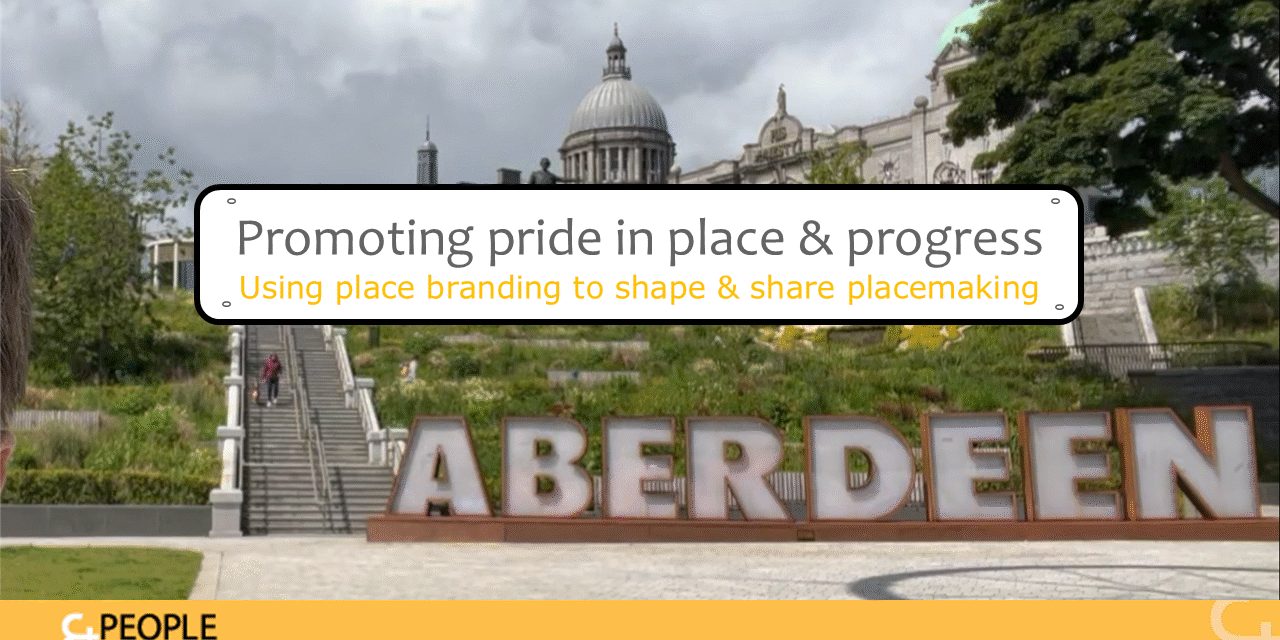
What are the opportunities for promoting pride in place through progress shown in re-shaping our town and city centres? Here I share my findings from taking a detailed look at the role of place branding in shaping and sharing placemaking and urban development, to help engage stakeholders and create a greater sense of local belief.
Not what our cities “used to be“
Last year I visited Aberdeen during its Nuart Festival and I was not only blown-away by the world class street art, though also by the city’s wonderfully remodelled Union Terrace Gardens, its impressively refurbished Art Gallery and Museum, and the passion of the ‘Our Union Street’ initiative to enhance the streetscape and business mix of the historic centre. So, imagine my surprise recently, to recount this experience to a couple of Aberdonians in a chance encounter and be greeted with, “Aye, but the city centre isn’t what it used to be!”
Surprise…well not totally! Residents are often foremost in putting down their local town or city centre. Often, they have lost ‘pride in place’ due partly to what we call ‘negative nostalgia’ caused by the symbolic loss of national retailers. Perhaps too, they are unaware or do not feel fully engaged in progress to reshape the look and feel of their town centre through changes such as finding new uses for buildings, improving the quality of public spaces and bringing the streets to life through cultural events. Previously, place branding in many cities, including Aberdeen, has not seen the need to direct its focus to local audiences.
Co-creating and communicating progress
It is such experiences that have led me in recent years to explore how we communicate progress in improving town and city centres and involve local stakeholders in co-creating responses. Fast forward to me having undertaken a post-graduate course and two international training modules in place branding, attended two global conferences and taken a deep dive through my own place-based research -including in Aberdeen.
What I have found is that place branding is a misunderstood and evolving discipline, with wider potential for the way it contributes to improving places. Yes, it grew-up on the external focus of promoting tourism and inward investment, and these remain important roles. No, it isn’t mainly about logos, straplines or describing pastiches of places.
Potential of place branding to change a city’s image
In its purest form, place branding involves having an awareness of a place’s current image, assessing the complete identity of a place with stakeholders and the intended audience(s), creating and curating a selective place brand identity to help improve the public image of a place.
For a city, the current position may be that its residents’ prevailing image is “things aren’t how they used to be”, while potential inward investors may have a limited or out-of-date image of the city. The role of place branding is to understand the rounded identity of a place, based on its past heritage, present qualities and future prospects, and to distil this into a distinctive brand essence and values that can be used consistently by key stakeholders.
More and more, place branders are understanding the need to capture a holistic view of place identity, that involves working from ‘the inside out’ and helping to influence the ways places are progressing. Many leading practitioners have come to regard residents as integral to place branding because they are key beneficiaries, bring a place’s identity to life, and make the best place brand ambassadors.
Pride in place through place branding & placemaking
Here I share ten pointers about what I have learnt about the potential role of promoting pride in place through progress and the application of place branding with placemaking:
- Determining the scope and role of place branding: Place branding has the ability to take a joined-up approach to shaping users’ experience of place, including by influencing and explaining urban policy. To help galvanise ‘pride in place’, place brand identity is best developed from the ‘inside out’.
- Clarifying the meaning of ‘the place’: An appreciation of the human characteristics of place is important in understanding how to curate a city’s image in the public mind: “Places are spaces given meaning by people”.
- Inter-linking place branding and the ‘re-imagining’ of cities: The key here, is developing the role of place branding in helping to drive the re-imagining of cities from the outset, rather than solely focusing on positively presenting the current position.
- Defining and engaging place brand partners, stakeholders and target audiences: These three sets of participants need to be engaged appropriately and openly as part of place branding, placemaking and wider urban development. Residents are key beneficiaries, part of a place’s identity and ideal brand ambassadors.
- Distinguishing control over levels of communication: Frame place branding in an understanding of managing the primary (experience of the place), secondary (place promotion) and tertiary (word-of-mouth and mouse).
- Putting partnerships in place for driving development and delivery: The development and delivery of a place branding strategy should be an ongoing process that constantly needs to be monitored and managed by a partnership of key stakeholders.
- Effectiveness measurement, monitoring and management: A systemic approach to the measurement, monitoring and management of combined placemaking brand strategy effectiveness needs to be built-in to initiatives from the outset.
- Adopting and adapting place brand identity processes: A part of broadening the scope and stakeholder involvement, recognised place brand identity techniques can be adapted to accommodate more audiences such as different resident demographics.
- Using values verses visual guidelines in brand delivery: The consistent application of the brand essence and values, backed by a new written narrative, is more effective than trying to enforce the use of visual guidelines amongst a multitude of stakeholders.
- Co-creating placemaking and place branding: Co-creation should be intrinsic to approaches that combine the development and delivery of place branding, placemaking and wider urban development. Place ambassador schemes are an excellent example of how stakeholder organisations and individuals associated with them, can follow-through involvement in say, a cultural development strategy, to participation in new, on-brand events to communicating the fit with the wide brand strategy.
How progress & place branding combine in Oslo
From visiting and listening to the creators of Branding Oslo, I have been lucky to gain great insights into a place branding process that prides itself on a co-creative approach in the way it was developed and is applied. The Greater Oslo Brand Management Strategy puts a strong emphasis on the experience of the city and the application of consistent messaging about its core qualities of being ‘real’, ‘pioneering’ and ‘enriching’. It’s definitely a case of ‘actions -and stories- speaking louder than logos’: “Oslo is the brand: People feel a sense of belonging, attraction, and a desire to come and to stay. In this sense, it is the place itself which is the brand, not a logo or a visual identity.”
Two things are apparent to me about the inter-relationship between placeshaping and place branding in Oslo: 1. Some of the language of placemakers and planners was woven into the branding strategy; 2. And yet it seems there was no formal, joint working with city centre masterplanners and cultural development strategists. As such, Oslo is both a case for the synergies between place-shaping and place branding, and an example that stakeholder engagement can at least infuse one discipline with the other.
My understanding is that the current focus is to bring the two parts together, with the city’s government becoming active partners in the brand strategy. This is fuelled by recognition that largely it is the same factors that make Oslo attractive to its own residents, skilled workers, visitors, and in attracting investments. The aim is to build on the externally-focused success and enhance the visibility of Oslo as a brand by engaging internal audiences in ways that it considers in-line with the trend shown by other leading cities.
“We are all Oslo ambassadors and co-creators of the Oslo brand. Let’s enable and encourage all citizens to share Oslo with the world.”
Is it even a city?
So what is the learning from my deep-dive into the world of place branding expressed in my ten pointers about its potential role in promoting pride in place. If you haven’t seen it, take a look at this tongue-in-cheek video titled, “Is it even a city?“, from the people behind Oslo’s branding. It is almost as if it was created as a repost to the jaundiced residents of Aberdeen and many other towns and cities, as a way of encouraging them to take a new look at their hometown.
My learning is manyfold, though can be summed-up in a belief that there is a key role for place branding developed from an ‘inside out” perspective, to share and shape progress in re-imagining our town and city centres. This can be achieved in ways that will get residents and other local stakeholders believing in their hometown. Place brands grounded in uch local self-belief, become easier to communicate to outsiders authentically, who then will be more mindful to experience, and perhaps invest in, the places we proudly call ‘home’.