
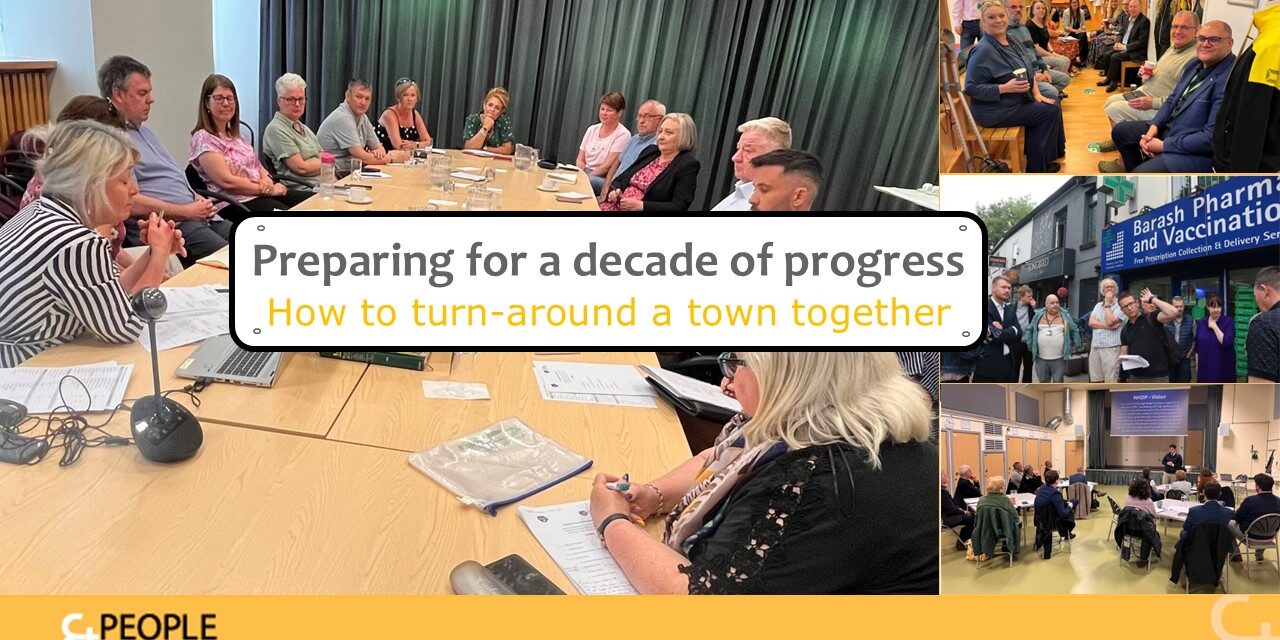
How can stakeholders in your town or city work together in preparing for a decade of progress? A big part of our work at the People & Places Partnership, is helping local councils, communities and business to come together to turn-around town and city centres.
Here we look at the ways ministers’ comments to last week’s session of the House of Lords High Streets Inquiry might inform the ways communities come together to shape the ‘how’ of revitalising town centres. This can be read alongside our already pblished insights into the ‘what’ of predicting high street policy. Our focus here, in preparing for a decade of progress, is based on a believe that it is the necessary timescale for revitalising town centres to work to.
Putting faith in partnerships
Ministers showed faith in the evolution of local partnerships as a way of ensuring that stakeholders are engaged in decision-making through business, the local authority and the community working together. The recent experiences of operating ‘Town Boards’, were cited as something that could be a good model for many communities, backed by best practice.
This was supported by much reference to the delegation of decision-making through devolved areas. It will be important for stakeholders to be clear about the administrative level of such delegation, which will vary between Combined Authorities, Unitary Authorities, County, District, Borough, City and possibly Town Council levels.
Taking a local lead
Our message is for local authorities to take a lead in reviewing the coverage, role and operation of existing and potential new town partnerships, whilst being mindful of the “devolved areas” that any funding may be distributed through. We know through our role in the former West Midlands’ Mayors Town Centre Task Force, that clarity is key.
Advising on the role and evolution of town boards or partnerships was big part of our expert role supporting the government-backed High Streets Task Force over recent years. Our methodology used in advising on the evolution of the Lincon City Place Partnership, for example, would be very relevant to Town Boards in many other places.
Following an equitable approach
Within this there was recognition that some local authorities’ lack of capacity should not mean that their communities miss out. The importance of involving underrepresented groups perceived as usually getting left out of consultation processes was highlighted. Equally it was stated that there is a danger that the communities with the best mix of skills -people with the most time and perhaps the most confidence- can benefit the most, which could widen inequalities. It is very important that alongside that you have enabling capacity to help communities that might need a bit of assistance and someone to stand with them.
The instincts of the ministers expressed in their comments was that the local authorities will be driving force to shape place, with communities consulted. There was, though a slight nod to their roles as enablers in play in convening and empowering other town centre stakeholders.
Accessing national expertise
There was recognition of the role that national-level support structures had played latterly in supporting local authorities in their work with communities.
The Community Ownership Fund and the consortium of partners put in place to support more deprived communities was recognised as an approach that could be expanded to other issues. Similarly, the High Streets Task Force was referenced as a way of making best use of people who are experts in their field. The phrase used by both ministers though was that form should follow function, in determining the focus of any national support mechanisms. It may be that the focus of support switches to the wider growth agenda of already stated high street priorities such as tackling crime.
Providing future funding certainties
It is ironic that the first outcome of discussions framed in ministerial comments about ensuring future funding certainties, could be the withdrawal of some existing commitments. It will be a nervous period in the run-up to the Budget when commitments under Levelling Up Fund round 3, Community Ownership Fund round 4 and the Long-term Plan for Towns are examined to make sure that the finances are in place.
Allocating rather than competing
The ministers made a strong commitment to more allocative (not competitive), longer-term, single-pot settlements through local growth plans. These it was indicated, would enable greater local discretion with a lighter-touch central direction, though central priorities may be used to provide some direction. The fact that U.K. Shared Prosperity Fund was cited as a good example of a funding mechanism, should give communities and councils confidence to start determining priorities for from April 2025.
Reviewing Business Rates
Whilst the Ministers from MHCLG stated that tax policy is for the Chancellor to determine, they did reiterate the pre-election commitment on the ambition of levelling the playing field and giving high streets the chance to compete on an even footing, with other forms of retail. They confirmed that it is being actively looked at.
Next steps and further reading
We love working with councils and communities to get everyone rowing in the same direction through close coordination an clear communication. Our long-held belief is that it makes the critical difference in ensuring that your plans to improve a place actually happen and that its people are part of the journey. We are now offering a five-day baseline review of the strengths and potential evolution of town centre partnerships and plans. Contact services@people-places.net for more imformation.
Read about how we helped turn-around town centres working with the council, communities and businesses of the Causeway, Coast and Glen area of Northern Ireland. Tbis included aligning their approach with national funding schemes.
Take a look at our own Places for People Manifesto and gauge how these emerging government policies match with our aspirations. Arguably there is all to play for because our focus -seemigly like the government’s- is to determine policy and deliver locally!
People & Places are authors of the the Local Government Association’s revitalising town centres toolkit. This toolkit includes practical guidance on the locally-led revitalisation of town centres based on local stakeholder engagement.

