
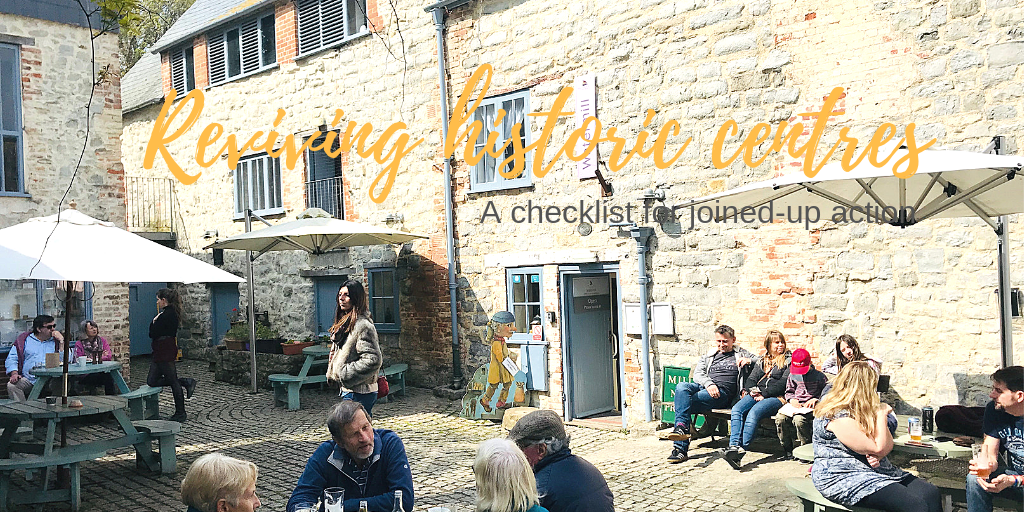
Reviving historic town centres and their role is not simply about a short-term injection of cash to restore heritage shopfronts or salvage a single historic building for re-use. Reflecting on Historic England and the Government’s £95 million investment in high street heritage action zones across 69 towns and cities, we consider the nuanced and integrated approach called for in accompanying guidance.
Such joined-up thinking confers with other leading experts and our own experiences at the People & Places Partnership as practitioners with a long track-record of reviving historic town centres. The Handbook and On-line Toolkit on Revitalising Town Centres that we prepared for the Local Government Association (LGA), demonstrates the role of heritage and streetscape as part of a fully integrated approach to regeneration.
Checklist of issues and resources
Here we provide a checklist of headline issues, accompanying resources and selected case studies. The aim is to assist potential applicants to either scheme in taking an integrated and long-term approach to reviving historic town centres. The checklist can be used to review thinking and commitments that need to stretch beyond these current, highly competitive funding opportunities.
-
Understanding the wider context
In their introductory, online guidance on Historic Town Centres and High Streets, Historic England recommend taking a user-led approach that understands the wider economic context for reviving historic town centres. Local market research, they suggest, is essential to identifying actions that will be relevant and appealing to the existing and future customer base. The LGA case study on gathering town centre evidence in Southwold outlines some suitable research techniques to underpin such customer-led approach.
Necessary solutions will require an integrated approach and may need to involve looking at addressing endemic issues and structural challenges, including through property investment. Historic England’s report on The Changing Face of the High Street includes important policy background and insightful case studies demonstrating innovative approaches that make the most of the local historic environment. This is important at a time when people are increasingly looking for a leisure experience rather than simply a range of shops to visit. The report concludes that such an approach to reviving historic town centres can help in creating a greater sense of ‘destination’ and potentially competitive advantage.
Case study: Integrated renewal in Rotherham
Rotherham is cited by Historic England in The Changing Face of the High Street as a striking example of a town that is overcoming formidable odds to revive its retail and town centre fortunes. Prolonged activity in Rotherham has combined environmental measures, financial help for investors, incentives for shoppers, a vigorous marketing campaign and Government assistance through the Empty Shops Initiative. As part of this the historic character of the town’s compact centre was used as a positive asset in promoting the town and an Edwardian arcade was restored. The local authority used its role as a property owner to kick-start investment and supported a Business Vitality grant scheme to support niche businesses to raise the quality and profile of the town centre. The retail effort has been complemented by wider town centre initiatives, including a programme of outdoor events and public realm works.
-
Creating constructive conservation
Focusing on the historic core of town centres is important to genuinely combine commercial and conservation interests in a way that will win the trust of key stakeholders such as civic societies. ‘Constructive conservation’ is the term Historic England uses to define the protection and adaptation of historic places through active management. In its guide on Valuing Places, Historic England offers examples of how this has been achieved through long-term conservation programmes developed gradually over many years in reviving historic town centres.
Conservation areas and listed buildings reflect the value placed by communities on heritage and any proposed changes need to be handled sensitively. Instead of being considered a constraint, it is important to consider such heritage recognition as an opportunity to increase the appeal of town centres. Well-managed change can bring with it the investment and care necessary to keep conservation areas in good condition. Poor management can result in neglect and decline, increasing the risk that the character of places of great historic importance will be lost for ever.
Mechanisms such Neighbourhood Planning, Town Centre Investment Zones and Community Land Trusts (where social housing is part of the mix) are potential mechanisms for accounting for and possibly cross-subsidising the commercial benefits of ‘constructive conservation’.
Case study: Reinforcing distinctiveness in Truro
Truro is one of a number of case studies of approaches to constructive conservation in reviving historic town centres referenced by Historic England in Valuing Places. The case study explains how the proposed doubling of Truro’s size required major strategic and conservation issues to be addressed in a long-term development vision. The result was a coherent vision of the city’s growth, in which the conservation area management plan has helped shape policy on parts of the city well outside the boundaries of the conservation area itself. According to Historic England, the approach demonstrates how constructive conservation management can inform major growth, so that it reinforces local distinctiveness rather than eroding it.
-
Improving streetscape & foot-flow
The historic core of town centres can serve both as an attraction and a constraint in encouraging foot-flow. It is important that regeneration schemes maximise the draw of the historic streetscape and public realm through an understanding of how users perceive and move around town centres. Details of what to consider are set-out in Streets for All, Historic England’s guide for highway and public realm works in historic places. The guidance sets-out how streets can be made more accessible for all; safer; sociable and healthy; high quality and distinctive in ways that bring measurable economic benefits.
Backed by regional supplements, Streets for All gives examples of progressive local authorities that are updating their access strategies based on much better understanding of pedestrian movement and desire lines. Such progressive management of the street environment and pedestrian network can re-establish historic links between the different parts of a town centre. The guide also includes suggestions for enhancing the distinctiveness and attraction of streetscapes through heritage audits and other useful techniques.
Case study: Designing for foot-flow in Bury St Edmunds
Bury St Edmunds is referenced in Streets for All as having adopted the approach of Historic Core Zones where well-designed traffic measures combine access and conservation objectives to improve foot-flow around the town centre.
Bury St Edmunds is a traditional historic market town that was facing increasing traffic pressures that created conflicts with pedestrians. After extensive consultation, solutions agreed included introducing a 20mph zone with minimum traffic calming measures and HGV weight restrictions, rationalising traffic signs and providing more space for people through partial pedestrianisation. Nearly two decades on from the initial improvements, the high-quality scheme remains well maintained and enables foot-flow between the historic town centre and Abbey Gardens without adversely restricting traffic.
Sleaford in Lincolnshire provides another example of positively influencing access and foot-flow in an historic town centre. In this instance, North Kesteven District Council undertook a customer-led review of parking provision that resulted in a joined-up approach to managing parking quality, quantity and cost to influence how the historic town centre is accessed and used.
-
Restoring and reusing iconic buildings
Restoring iconic, historic buildings for new uses can be an important part of increasing the attraction and foot-flow around town centres. As well as the physical transformation, necessary work will include capacity building, business planning and consideration of how the building fits in to wider plans for the town centre. The Architectural Heritage Fund advise that such restoration schemes should not be standalone but sit within a wider initiative to regenerate and bring a new purpose to the immediate surrounding area. The development of any such scheme and financial planning will involve a combination of project feasibility studies; fundraising including different forms of social investment; project management; capital works; business development and maintenance.
Case study: Restoring & reusing Peckham Fire Station
The Architectural Heritage Fund (AHF) web site includes a number of case studies of historic building restoration projects including the Peckham Road Fire Station in London. The semi-derelict Fire Station was donated to the South London Gallery in 2014 and opened to the public in September 2018 after a £4 million conversion and restoration. The Fire Station is now a contemporary arts space providing gallery spaces, an archive room, artists’ studio, kitchen and terrace, combined with community and education facilities.
The AHF provided early stage project viability to contribute towards the costs of business planning, quantity surveyors and architect fees. This funding acted as a catalyst enabling the Gallery to complete feasibility and development works, secure additional funding and be ready to begin capital works.
Lyme Regis Town Mill is another example of a historic property that has been restored and reused as an arts, crafts and community attraction. Like the Number 8 Community Arts Centre, Pershore; The Brewery Arts Centre, Kendal and Galeri Caernarfon, the Mill is an example asset-based development where iconic buildings earn their keep within their towns ; are community-owned and managed; and provide a great service that helps bring a place to life.
-
Working through collaboration & partnership
With so many different stakeholders and interests represented in compact areas, it is important to work in collaboration to make best progress in restoring and reviving historic town centres. There is no ‘one size fits all’ way of bringing interests together and instead, as Historic England states in its online guidance, these can be formal or informal partnership arrangements based on particular developments or on a programme of activities and events.
In a recent joint LGA and Chief Cultural and Leisure Officers Association (CLOA) publication on the Role of Culture in Placemaking, there is a strong emphasis on the processes and partnership working required for effective delivery. The report showcased a range of different approaches to placemaking that all share common ‘success factors’, including effective community engagement, strong partnerships, local champions; demonstrating success to unlock further funding opportunities.
It is important for any regeneration scheme focused on reviving historic town centres to integrate with other interests and actions as set-out broadly in the LGA Handbook and On-line Toolkit on Revitalising Town Centres. Key aspects aspects to consider are community engagement and coordination and streetscape and public realm. It is also important to work with stakeholders to facilitate place branding and marketing; digital technology and data; property and planning; parking, access and travel; business support.
Case study: Delivering success through partnership in Margate
The LGA and CLOA publication on the Role of Culture in Placemaking showcases Margate as case study of how historic environment and character can play an integral role in a partnership-based, successful revival of a place.
Since 1999 the Margate Old Town Heritage Initiative has brought different interests together to help transform previously neglected buildings into attractive, desirable properties. Many of the shop fronts have been renewed to historic patterns and the public realm improved. This has made a significant difference to the local economy, attracting new shops, restaurants and other businesses, and has made the Old Town a more vibrant and appealing place for people to live in, work in and visit. Elsewhere the designation of a neglected Victorian Square as a Conservation Area has helped attract similar levels of investment and empty properties have been brought back into use. The cultural outcomes achieved by this and other partnership work in Margate include: major local attractions opening or reopening; a 32 per cent growth in the number of businesses working in arts, culture and the creative industries; a 71 per cent increase in the number of artists’ studios.
More information
The Government’s announcement about the recipients of the funding can be read in full here.
Extra guidance on the High Street Heritage Action Zone is provided by Historic England in a useful set of answers to frequently asked questions.
Get in touch
If you would like to discuss issues raised by this post or perhaps to have an informal chat about any aspect of reviving historic town centres, send an email to chris.wade@people-places.net or give Chris a ring on 07788 278126. Chris is always up for a chat with people who care about their community or is happy to have a coffee and a chat in an historic town centre.


1 Comment