
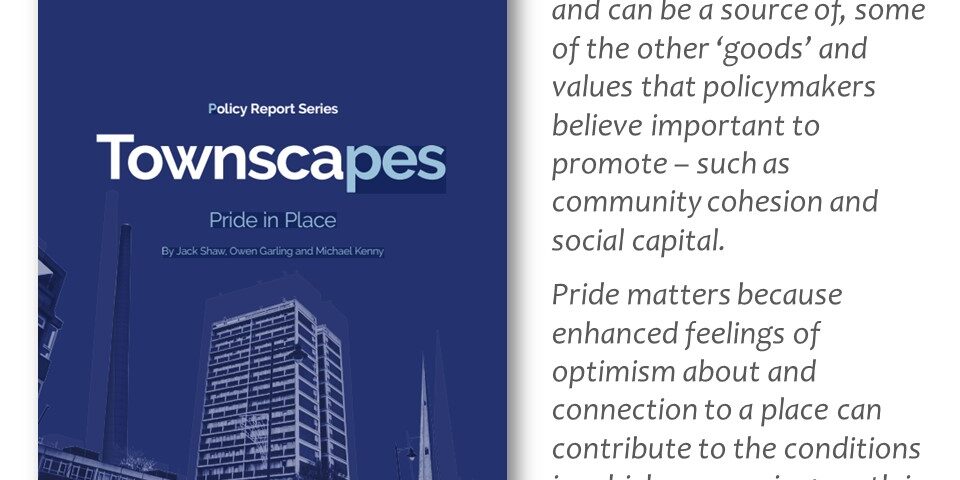
This policy report from University of Cambridge’s Bennett Institute offers insights about the meaning, measurement and relevance of townscapes and pride in place as a focus for boosting the economic and social wellbeing of our towns and cities. This townscapes and pride in place report is a recommended read for anyone grappling with the Levelling Up White Paper’s focus on ‘pride in place’ and what this means as a driver for local interventions.
Defining ‘pride in place’
Like any good academic paper, the report begins by grappling with definitions of ‘pride in place’. It notes that it’ is a relatively new invention in British political rhetoric and first figured in the then Prime Minister’s speech on levelling up in July 2021, when he talked about ‘restoring pride in place’ as one of the central planks of his vision for creating a more balanced economy. It is one of a family of similar phrases, such as ‘local’ and ‘civic’ pride, which have come to prominence in recent years.
Relationship between people and places
The report recognises that the importance given to relationships between people and places, reflect a new kind of understanding and associated policy objective linking townscapes and pride in place . And this is not confined to the Conservative Party: Labour’s Shadow Levelling Up Secretary, Lisa Nandy MP recently outlined the need for culture, identity and history – constitutive elements of pride in place – to be “reflected in the national story”.
Criticisms of concept
The report acknowledges how critics argue that rather than focusing on questions about identity and culture, government should prioritise addressing the underlying causes of the economic challenge which poorer towns and ‘left-behind’ communities face.
The report offers a particular challenge to the idea, which is integral to the analysis offered in the Levelling Up White Paper, that a sense of pride has been diminishing in many poorer areas, towns and communities in recent times – and now needs to be ‘restored’. It outlines how there is a good deal of evidence which indicates that some of the places with high levels of local pride are among the more deprived areas in the country. This is in-part counter to the link proffered through the White Paper about monitoring pride in place.
Shortcomings of regeneration
The report is in part critical of some of the perceived shortcomings of regenerations activities in relation to townscapes and pride in place. It states that often regeneration is associated with the feeling that distant authorities are making decisions about an area without consulting the local community, often with commercial motives to the fore, rather than local needs. There is a close association in the popular mind with regeneration programmes and outcomes like gentrification.
Platform for economic activity
Ultimately, the report is supportive of policy moves to link people’s perceptions with improving places and suggests it provides a platform for boosting economic activity. It advocates that “pride in place is linked to, and can be a source of, some of the other ‘goods’ and values that policymakers believe important to promote – such as community cohesion and social capital. Pride matters because enhanced feelings of optimism about and connection to a place can contribute to the conditions in which economic growth is more likely to happen.”
Townscapes series
This report is written by by Jack Shaw, Owen Garling and Michael Kenny. It is part of the Townscapes series at the Bennett Institute for Public Policy that seeks to offer a deeper analysis of how towns are faring across the regions and nations of Great Britain. The Bennett Institute states that its aim is to step away from the oversimplification and dogma that features in much of the contemporary policy debate and offer a more finely grained picture.
More information
Download the Bennett Institute’s townscapes and pride in place report from our library of recommended reads.
Read our earlier blog about monitoring pride in place draws on the report published last year by Demos, Everyday Places: Creating strong locations to support daily life in Britain. This Demos report is one of the studies cited as providing insights into assessing what matters for monitoring pride in place and local area satisfaction in the UK government’s technical report, Levelling Up the United Kingdom: missions and metrics.
Find out more about the Shared Prosperity Fund and the opportunities it provides for sharing prosperity across our towns and cities, including how to get hold of our free guide from People & Places on the Shared Prosperity Fund & its opportunities for communities, place & local business.
The People & Places Partnership are creators of the Local Government Association’s national guidance for local leaders on revitalising town centres toolkit. This toolkit includes practical guidance on approaches to post-COVID 19 recovery planning and levelling up, with a methodology that can be used in Shared Prosperity Fund investment planning and delivery.

