
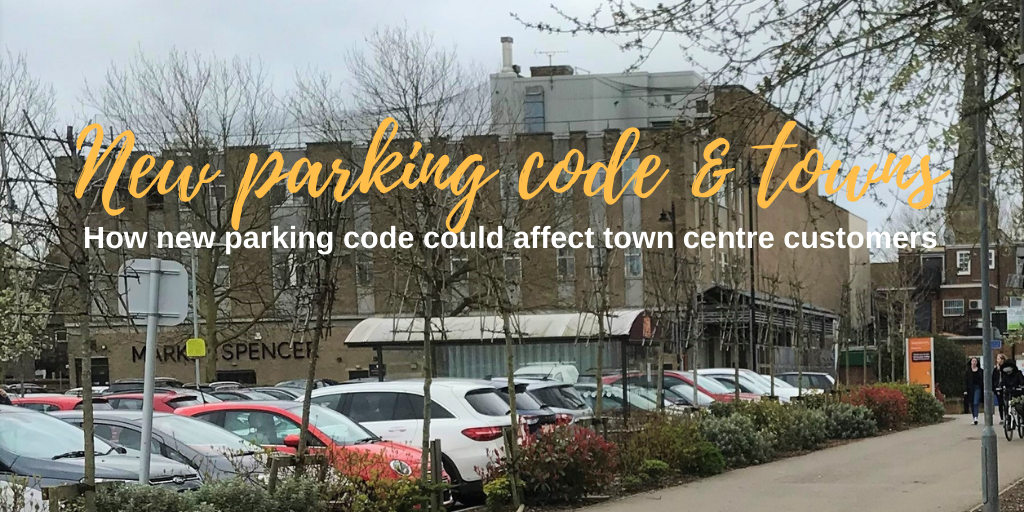
What is the new parking code and why might it matter to the vitality of town and city centres?
Amongst a raft of new measures recently heralded by the government as helping to prepare our high streets and seaside resorts for summer reopening, was an announcement of changes to private parking enforcement. The government said that its proposed new parking code of practice provided a series of fairer parking measures which will benefit motorists and encourage people to return to high streets and town centres.
Affect on supermakets and retail parks
These changes will affect privately run car parks around supermarkets and retail parks that often offer customers two to three hours of free parking on the edge of smaller town centres in particular. Such car parks offer the possibility to combine a supermarket shop with a trip to local town centre stores such as a butcher or baker. So, any easing of restrictions on the face of it, seem like good news for shoppers and town centres in such instances.
End of ‘free’ parking
Is there such a thing as free parking though and how will the new measures affect the way car parks are managed to ensure customers can park when they want where they want? The industry body representing parking providers, the British Parking Association (BPA), says it fears the changes could lead to the end of free parking at supermarkets and retail parks, alongside management of private car parks by rogue operators who will not adopt the new code.
Pay to stay or over-stay
To understand the response from the BPA on behalf of parking operators it is helpful to understand the way that parking management is funded to provide a service for town centre customers. Two of the most common approaches, we define broadly as:
Pay to stay: Favoured especially by local authorities, this includes the familiar pay and display or pay on exit typical of multi-storey car parks. Revenue to run the car parks largely comes from sales, often supplemented by additional penalty charges.
Pay to over-stay: Favoured by private parking operators managing supermarket car parks, for example. Parking is free for a restricted period and effective enforcement is often sub-contracted to ensure a turnover of spaces through stringent fines.
Reduced penalty charges
The new government code is proposing that the penalty charges for the ‘pay to over-stay’ model will typically be capped at £50 with a 50% discount for early payment. A higher penalty charge of £100 will apply for the more serious breaches such as abusing a blue badge parking bay.
Shoppers could be pushed out
The BPA believes that the new measures will have unintended consequences for customers including those of town and city centres. They comment that those private car operators currently providing free parking – for supermarkets and the retail sector – are deeply concerned their customers will be pushed out by commuters and local workers, who are looking for a cheap day’s parking. This, they say, could lead to the end of free parking at supermarkets and retail parks in towns and cities across the UK.
Steve Clark, BPA Director of Operations and Business Development said, “Government must rethink this. Nobody wants the supermarkets and the retail sector to be forced to charge their customers for parking because of the inability for them to control abuse of spaces with a deterrent that is ineffective.”
Impact on place
From a place leader’s perspective, a key issue to watch is whether this will lead to supermarket and retail parks introducing “pay to stay”, customer only or technology-led controls as part of future parking management. This might encourage customers to park in different parts of town. Alternatively, the reduced deterrent may increase the appeal of parking in supermarket car parks. This will especially be the case in popular destinations where a £25 penalty is cheaper than paying to park elsewhere.
Place leaders will need to monitor the possible local impacts of the new code over the coming year, alongside other factors such as the impact of the COVID-19 pandemic. As ever, it will be important to understand the local customer needs plus the parking supply and demand to adjust a town’s parking strategy accordingly.
Understanding people, places & parking
At People & Places, we can help understand the impact of changes in the parking code and wider demand on places. We have taken our understanding of town centres and combined with Park Consult’s experience of parking management, to offer a comprehensive and cost effective People, Places & Parking Process consultancy service for councils, business groups and parking providers. This takes a customer-focused approach to understanding how to adapt the quality, quantity and cost of parking provision to changing circumstances. An initial first level review provides a quick and inexpensive way to reassure place leaders about the probable impacts of the code and assess other opportunities for improved parking for customers.
Take a look at the LGA guidance on town centre travel, parking and access; read the LGA case study of our work linking parking and place in Sleaford that uses our process.


The food is reasonably priced for the health-conscious consumer – and they do organic so well!! Locally owned; since they moved to this new location there is MUCH more to recommend it