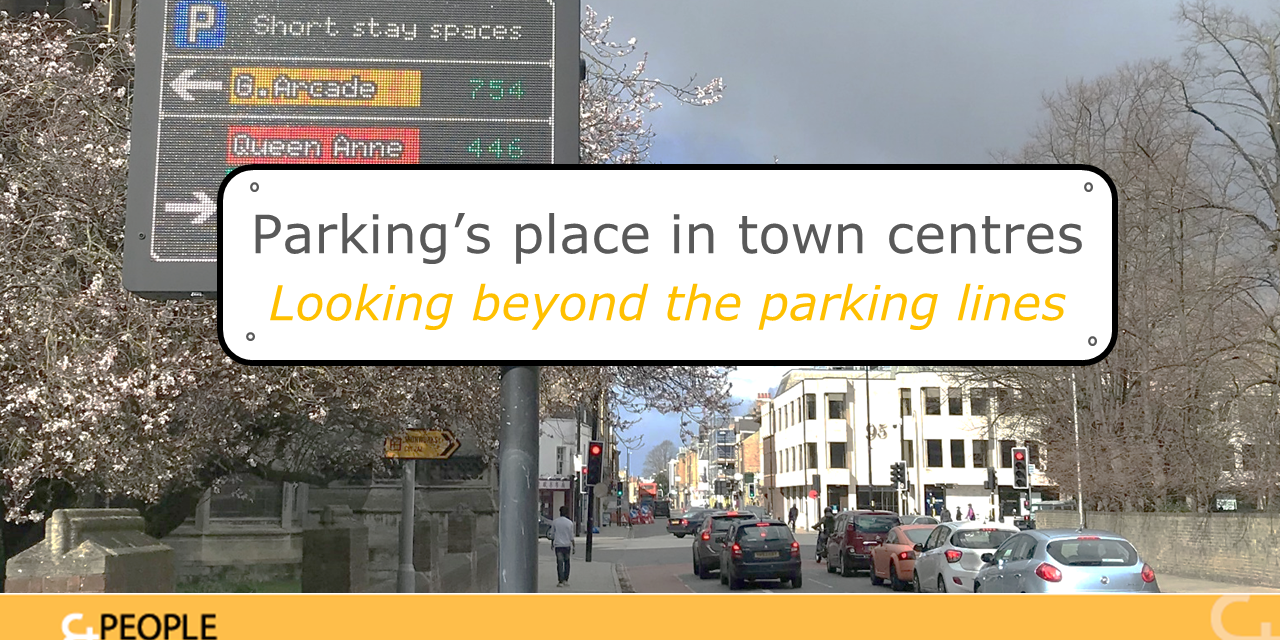
It is important for local authorities to take a broad perspective on the place of parking in town centres. That was my message in recently addressing council members and officers at a Local Government Association event on parking and high streets. My thought was to challenge participants to think beyond the silos of their own responsibilities for highways, parking or town centre revitalisation.
Looking beyond the parking lines
Changing perceptions and practices about the place of parking in town centres, requires joined-up thinking and action. I wanted to encourage participants to look beyond car parks’ white lines, on-street yellow lines and the battle lines that seem to divide opinion. My aim was to point participants to ways that parking provision can adapt as part of an evolving town centre experience.
Listening to stakeholders
The journey to town including parking, is one of a range of issues covered in the revitalising town centres toolkit prepared by People & Places for the LGA. The toolkit see that it advocates an evidence-led and joined-up approach to revitalising our town and city centres. The approach begins by listening to town centre businesses and customers.
As recent stakeholder engagement by People & Places across Hertfordshire towns shows, for example, improving parking and travel to town are often amongst the top priorities for stakeholders -especially town centre businesses. Other top priorities often include diversifying the business mix; enhancing the streetscape and movement around town; bringing the centre to life through marketing and events. Parking needs to be addressed alongside these other issues.
Measuring town centre and parking performance
As well as stakeholder perceptions, at People & Places, we also use metrics about town centre and parking performance to test perceptions of parking provision. Amongst the most common scenarios represented here, a shortage of parking provision is only a limiting factor for around for 20% of town centres, sampled. For other towns, it is very a case of needing to challenge stakeholder, negative perceptions about the relationships between parking and place. Very often it would seem, parking provision is unfairly blamed for businesses’ woes and the solutions lies in changing how parking is perceived and used as part of the journey to town.
Addressing quality, quantity and cost
As this LGA good practice case study on linking people, place & parking in Sleaford town centre demonstrates, a focus on the town centre customer experience involves a detailed look at three aspects of parking provision. These three aspects are: quality including convenience and waymarking; the quantity to balance the availability for different types of town centre users; and cost as a way of influencing the use and turnover of parking spaces. Its an approach that we have developed into the People, Places and Parking process that can readily and cost-effectively be applied to any town centre.
Parking actively
Coincidentally, the Sleaford case study advocates a form of Park Active for visitors who will enjoy riverside walks as part of their introduction to the town. And for workers who can ger better value if they walk or cycle from peripheral car parks. Park Active is a British Parking Association initiative which aims to help improve health and wellbeing, reduce congestion and carbon emissions, cut down on the cost of travel and provide support for high streets and city centres. This introductory video about enabling active travel choices through Park Active shows how the scheme operates as part of the city centre experience for Brighton and Hove.
Tracking travel trends
As part of the People & Places Partnership holistic view of town centres -and our enthusiastic focus creating an appealing journey to town- we also keep a keen eye on trends including active travel. This includes tracking active travel trends for place leaders revealed by taking a close look at the data in the UK Walking and Cycling Index and a detailed review of the post-pandemic direction of travel. We do not do this to evangelise about the benefits of active travel though rather seek to present objective facts to inform understanding and decision-making by place leaders. Though I did enjoy the cycle track pictured that connects Newcastle and four Tyneside towns where we have been working!
And that really is key to how we see understanding the evolving place of parking town centres. Drill down on the data to understand the issues and adapt.
Making more of towns
Such drilling down into the data; tracking foot-flow and engaging with stakeholders can help us look differently at places and how we travel into and around them. Take Whitley Bay for example, where you can readily arrive by bike, bus, Metro or car. Enabling active travel within the town can help users make more of the different parts of the town.
Public perceptions of parking
It was great to hear insights from the British Parking Association’s survey on public perceptions of parking, alongside my presentation. Here are some of the key statistics from the survey that resonate with my professional and personal experiences of the place of parking in town of centres.
Satisfaction with parking
Availability of spaces (49%), convenience (39%), cost (25%) and safety (23%), were the main reasons stated as to why people are satisfied with parking overall in their local area. From a place management perspective about the journey to town, it was insightful to learn that lack of congestion (17%), easy access to active travel for destination (14%), and easy access to public transport links (13%), generate significant responses.
Deciding where to park
Cost (24%), proximity to the final destination (22%), and safety (16%), were cited as the single most important factors when deciding where to park. In terms of onward travel, it is interesting to see the variety of stores (3%), park and ride links (1%), and access to onward cycling/safe walking, getting modest responses as the single most important determinants. I would have liked to have seen the percentage of responses citing availability of spaces as a key factor.
Paying for parking
Opinion is divided on whether people should pay for parking, with 44% in favour and 42% against. Over half of people surveyed (58%) though, feel the cost of parking is about right. The average people are willing to pay for parking for shopping or leisure trips is a modest £1.65. People will readily walk 5-7 minutes in order to obtain free parking. 4 in 10 respondents said that they would no longer use High Street parking if the price was to increase.
In terms of payment method for parking, which can affect how people use a town centre, the most popular timing for payment was on exit (49%), followed by on arrival (37%). Emerging options such as in advance (5%) or by midnight after leaving a car park (4%), got much more modest responses. The most popular method of payment is card, and its popularity has doubled since the last survey in 2019. This is followed by cash payment although its popularity has decreased. Satisfaction with paying for parking by phone or text has remained stable.
Sharing what works
At People & Places, we love sharing what works –and learning from what doesn’t! For example, we run a LinkedIn group called ‘Talk of the Town’ and a page showcasing tips about joining up People, Places & Parking. If you have queries about some of the evidence referenced here or want to learn more about our wider work, you can always contact us through services@people-places.net or visit our keep in touch page.
A video presentation illustrating the points made in this blog about the place of parking in town centres, is available on the People & Places Partnership’s YouTube Channel.
If you would like to know how People & Places can help you review the role of parking in your town centre, take a look at or guide to the People, Places and Parking process. This service is operated jointly with parking management specialists, Park Consult. There are three levels of service beginning with a two-day overview of parking operations, their wider impact on town centre prosperity and an identification of opportunities to enhance parking operations. Again, contact services@people-place.net for more information.